To make a visual novel, write a story of about 5,000 words per playthrough (roughly half an hour), plan four or five choices that mostly merge back together, and build it in Ren'Py with placeholder art before you draw anything. Ren'Py is free, open source and allowed for commercial games, and its script reads almost like a play.
We make Oryn, an AI game maker. It isn't a dedicated visual novel engine, so this guide recommends Ren'Py as the default and gives Oryn one small section near the end. Prices and versions are from the makers' pages as of November 24, 2026.
How long should a first visual novel be?
Count the words one player sees, then convert. Two sourced numbers bracket the answer.
A meta-analysis of 190 studies puts silent reading of English fiction at 260 words per minute. That's the fast end. Players also wait for transitions, look at art and think about choices, so developers plan slower. The maker of A Noble Pursuit budgeted 2,500 words for about 15 minutes, which is 10,000 words an hour.
| Play time | Words one player sees (10,000 an hour) | At pure reading speed (260 a minute) |
|---|---|---|
| 15 minutes | 2,500 | 3,900 |
| 30 minutes | 5,000 | 7,800 |
| 1 hour | 10,000 | 15,600 |
| 3 hours | 30,000 | 46,800 |
Use the first number column. Then expect to overshoot: the same developer had 6,000 words on the page and had only reached the climax of that 2,500-word plan.
Two real sizes to compare against:
- The Question, the example game that ships with Ren'Py: 768 words of script by our count, two menus and two endings. It has one character in two outfits with four expressions each, four backgrounds and one music track.
- one night, hot springs by npckc: about 30 minutes and seven endings, according to its page. Players on VNDB average 41 minutes over 48 reports.
Branching that doesn't explode
Every choice that leads somewhere new doubles the writing after it. Five two-way choices that never merge need 63 scenes and 32 endings. If one playthrough is six scenes of 880 words, you'd write 55,440 words so that each player can read 5,280.
Merge instead. Most choices change a variable and a short reaction, then everyone meets in the next scene. Here's a worked example, a story about a missed ferry:
| Scene | Choice | What it changes | Merges? |
|---|---|---|---|
| 1. Kiosk | "I waited for you" / "I missed it" | trust +1 or 0, 120 words each | Yes |
| 2. Walk | Tell the truth about the ticket / lie | trust +1 or 0, 120 words each | Yes |
| 3. Fork | Harbour / station | route, an 800-word scene each | After that scene |
| 4. Call box | Share your last coins / keep them | trust +1 or 0, 120 words each | Yes |
| 5. Dawn | Ask her name / stay quiet | trust +1 or 0, 120 words each | Into the endings |
| Endings | None | Harbour with trust, station with trust, or apart; 500 words each |
Now the writing bill:
| Part | Words written | Words one player sees |
|---|---|---|
| Five shared scenes of 700 | 3,500 | 3,500 |
| Four choices, two reactions of 120 | 960 | 480 |
| Two route scenes of 800 | 1,600 | 800 |
| Three endings of 500 | 1,500 | 500 |
| Total | 7,560 | 5,280 |
Same half hour, same five decisions, about a seventh of the work of the full tree.
Check that people can reach your endings
There are 32 ways through that example. Suppose the good endings need trust of 3 or more out of 4. Then 22 of the 32 paths end apart, and only 5 reach each good ending. Lower the bar to 2 and it becomes 11, 11 and 10. Nothing in the writing changed. Count your paths before you decide your ending is too rare or too common.
Three more rules of thumb that keep branches honest:
- Pay something back early. A choice in scene 1 should be mentioned by scene 2, even in half a sentence.
- Never ask a question with one sane answer. If testers all pick the same option, rewrite the other one.
- Track feelings as numbers and facts as true or false. "How much does she trust me" is a number. "Did I lie about the ticket" is a flag.
Write it in script format
Write in the format you'll build in, so nothing has to be copied twice. Each line of a Ren'Py script is a speaker and a sentence, a stage direction, or a choice. A few habits help:
- Keep a line under about 25 words, so it fits two or three rows of the text box (rule of thumb).
- Put the pose change before the line it belongs to.
- Give each character one speech habit you could recognise with the name removed.
- Use one label per scene and name it after what happens:
kiosk_waited, notscene_03b.
Before the first full draft, write each scene as one sentence with its goal, its turn and the variable it touches. The one-page design document has a template that works for stories too.
A small Ren'Py script you can run
Ren'Py's latest release is 8.6.1, from November 17, 2026. Create a new project in the launcher, open script.rpy, and replace its contents with this. It uses one variable, one choice, one condition and two endings, and follows the current documentation.
define m = Character("Mara", color="#c96f4a")

default trust = 0

label start:

    scene bg kiosk
    with fade

    show mara neutral

    "The kiosk light is the only one left on the quay."

    menu:

        m "The last ferry went at nine. You knew that."

        "I was waiting for you.":
            $ trust += 1
            show mara smile
            m "Then you're a worse planner than I am."

        "I missed it.":
            m "So did I. Let's not talk about it."

    "Rain starts, quietly, as if it had been asked to."

    if trust >= 1:
        jump together
    else:
        jump apart

label together:

    m "Come on. I know a way that isn't on the map."

    "Ending: The long way round."

    return

label apart:

    m "Good night, then."

    "Ending: The timetable."

    return
Four things to know about it:
defaultcreates the variable so that it's saved with the game.$runs one line of Python.- The line of dialogue inside
menu:stays on screen while the player chooses. - Indentation matters. Use four spaces, never tabs.
- You don't need pictures yet. In developer mode Ren'Py draws a placeholder for any image that doesn't exist.
When art arrives, save it in game/images as bg kiosk.jpg, mara neutral.png and mara smile.png. Ren'Py names images after their files, so the script won't change. Run Lint from the launcher before every test build. It reports errors and statistics about the game.
The art list for a 30-minute visual novel
This list fits the ferry example. The counts are our rule of thumb, checked against two real games. One is The Question above. The other is a Spooktober jam game whose solo artist made four characters with 6 to 10 expressions each and six backgrounds, three of which were versions of one picture.
| Asset | Count | How to keep it small |
|---|---|---|
| Characters on screen | 2 | The player character is never shown |
| Poses per character | 1 | A second pose only if the script needs it |
| Expressions per character | 5 | Neutral, happy, sad, annoyed, surprised |
| Backgrounds | 5 places | Tint two of them for night or rain |
| Event pictures (CGs) | 2 | The turn and one ending |
| Title screen and cover | 1 each | Crop both from one large picture |
| Interface | 1 recolour | Ren'Py builds a default one from two colours |
That's 10 sprite images, 5 backgrounds plus 2 variants, and 2 event pictures. Draw expressions as separate face layers over one body and Ren'Py's layered images will combine them. Work larger than your game's resolution; the Spooktober artist regretted drawing backgrounds at exactly 1920×1080, and said each sprite took a few days.
If you don't draw, buy or download one matching set of sprites and one of backgrounds, not six that almost match. The game assets guide and our page on itch.io assets cover where to look and which licence lines to read.
Sound
Half an hour needs less than you think:
- three or four looping music tracks (calm, tense, sad, theme)
- one ambience per place
- about ten effects such as rain, a door, footsteps and a phone
Ren'Py plays Opus, Ogg Vorbis, MP3, FLAC and WAV, and finds anything in game/audio by name. Check licences as you download. On Freesound, CC0 needs no credit, attribution needs one, and attribution noncommercial can't go in a game you sell. Start with royalty-free game music, or write your own with how to make game music.
Visual novel tools and what they cost
| Tool | Price and licence | Best for |
|---|---|---|
| Ren'Py 8.6.1 | Free, open source (mostly MIT), commercial use allowed | Almost everyone |
| TyranoBuilder | $14.99 once, no royalties | Drag and drop, browser export |
| Visual Novel Maker | $59.99 once | Point-and-click editor with starter art |
| Twine 2.12.1 | Free, commercial use allowed | Text stories and testing branches |
| Naninovel | €138.01 before tax (on sale at €69 that day), runs in Unity | Unity teams, console plans |
| Dialogic 2 | Free, MIT, still alpha, needs Godot 4.5 or newer | Story scenes inside a Godot game |
| Chatterbox 4 | Free, MIT; GameMaker is $99.99 once to sell games | Dialogue inside a GameMaker game |
| Rosebud | Free to try; plans vary | An AI-assisted browser visual novel |
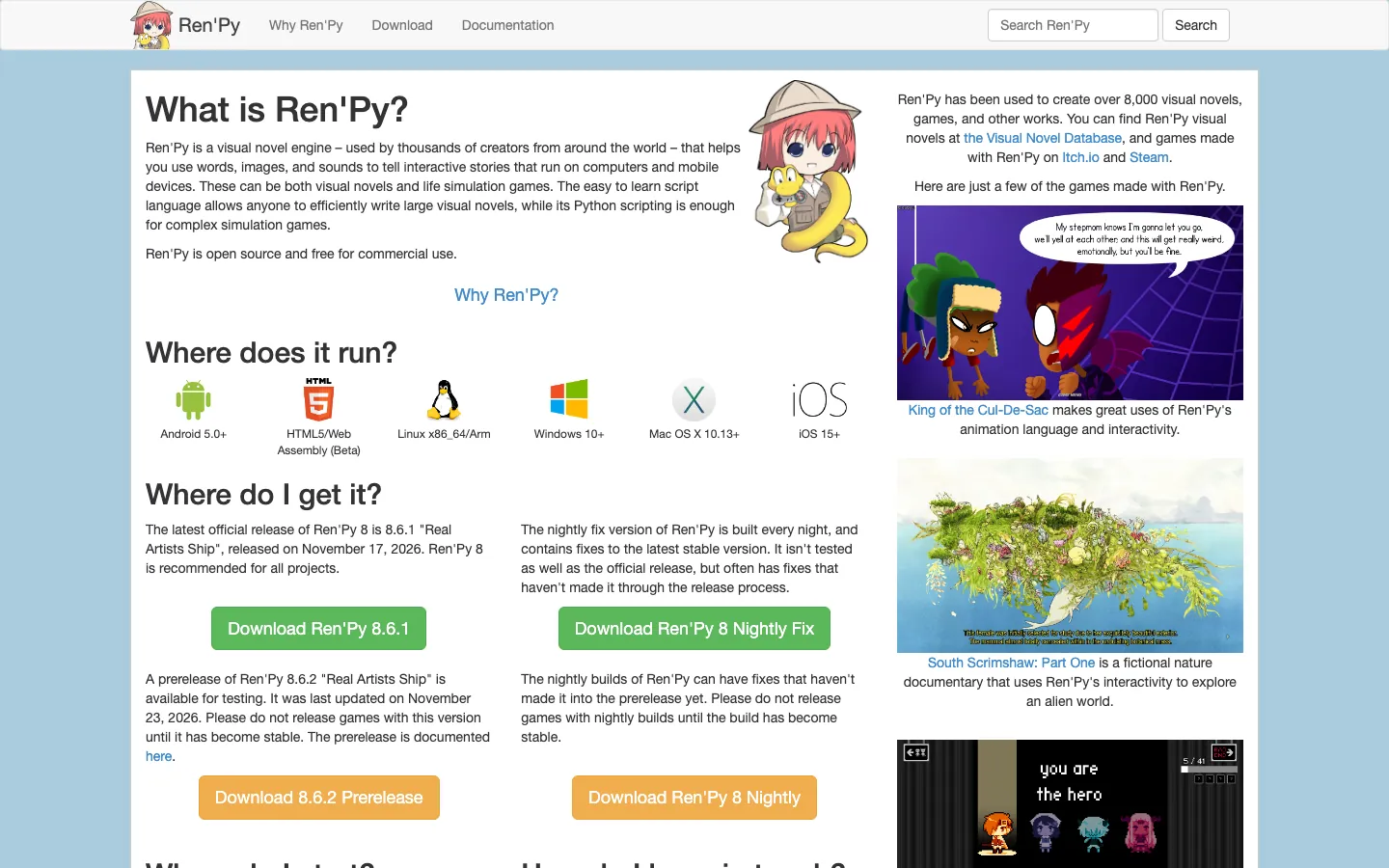
Ren'Py is our pick because saving, rollback, skipping, menus and translation are already there. It builds for Windows, macOS, Linux, Android, iOS and the web (the web build is labelled beta).
TyranoBuilder is a cheap way to avoid scripting. Twine is worth an evening even if you build elsewhere, because it shows your branches as a map.
Choose an add-on for Godot, Unity or GameMaker only when the story sits inside another game. If that's you, Godot vs Unity compares the two biggest options.
Where Oryn fits
Oryn makes 2D and 3D games from a description: you answer planning questions, approve a design document, and change the build in chat. If your project is text, sprites and choices, use Ren'Py.
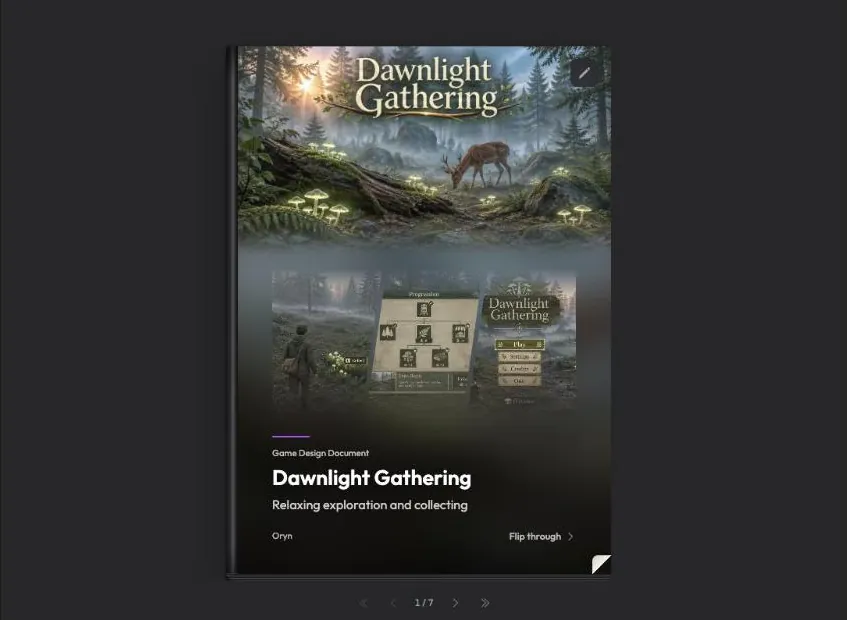
Oryn is an option when the story has a game around it: rooms to walk through, puzzles, a minigame between chapters, a small town with people to talk to. It draws the backgrounds and characters, makes a soundtrack and can speak your dialogue with generated voices.
Our visual novel maker page has the details, and RPG maker covers branching dialogue in a world you explore. You can plan one game for free, but building takes credits or a paid plan.
How to make a dating sim
A dating sim is a visual novel with a relationship number per person and, often, a calendar. Build it in this order:
Pick three love interests, not seven
Each one needs a want that isn't the player. If you can't say what they'd do on a day without you, cut them.
Budget the routes
A common part of 4,000 words, three routes of 6,000 and two endings of 600 per route is 25,600 words written. One player sees 10,600, about an hour.
Give everyone one number and one flag
In Ren'Py:
default ana_love = 0anddefault ana_secret = False. The number opens the route, the flag decides the ending.Set thresholds after counting
List the highest score a player can reach before the route opens, and put the gate at about 60% of it (rule of thumb). Make sure a player who likes two people equally still gets a route.
Add a calendar only if it creates choices
Ten days with two free slots each is 20 decisions. If most slots feel the same, use fewer days. For stat-driven events, look at the Ren'Py project's Dating Sim Engine.
Keep every character clearly an adult if there's romance, and answer the store's content questions honestly.
Publish on itch.io and Steam
itch.io first. You set the share the site keeps, from 0% to 100%, with 10% as the default, and payment processing takes about 2.9% plus $0.30 per sale. Its example leaves $8.41 of a $10 sale.
For a browser version, upload Ren'Py's web.zip. itch.io's limits are 1,000 files, 500 MB extracted and 200 MB for any single file. Ren'Py adds that browsers won't cache files over 50 MB, so compress music and backgrounds.
If generative AI made any of it, itch.io asks you to tag that accurately.
Steam second. The Steam Direct fee is $100 per game, not refundable, and paid back once the game has at least $1,000 in adjusted gross revenue. For your first titles, plan on:
- 21 days between paying and releasing
- a public coming-soon page for at least two weeks
- a build review of 1 to 5 days
- up to 30 days for tax checks
Steam's content survey also asks about AI-made content that ships in the game.
Steam's visual novel tag returned 12,934 games on November 24, 2026, so bring your own first readers.
Budget and time
You can do the whole thing for $0 with Ren'Py, your own art and itch.io. Add $100 for Steam. Art is where money goes, and we found no reliable public price list, so ask three artists for a quote on your exact list.
One developer published the real numbers. The Spanish Privateer, an otome of 228,000+ words with three love interests, started in 2018 and launched in fall 2022. Its maker put in about $1,000, and a second Kickstarter paid out 5,206.49 CAD. By January 2023 it had sold 162 copies on Steam. The maker earned back that $1,000 and lists not overspending among the best decisions.
For time, use a jam as a fence. NaNoRenO asks for a whole visual novel within March, and its 2026 edition had 94 entries. A sensible month for the ferry example (our estimate):
- one week to outline and draft
- one week for placeholders and choices
- one and a half weeks for art and sound
- the rest for testing
Playtest checklist
- Can they start? Title to first line in under 30 seconds.
- First choice: within about five minutes (rule of thumb).
- Skimming: watch for fast clicking and mark the line where it begins. Cut there.
- Regret: ask which choice they'd change. No answer means no choice mattered.
- Every ending: play each one from a fresh save, on the final build.
- Rollback and save: save mid-choice, load, roll back, choose the other option.
- Lint: runs clean, with no wrong names on any route.
- Text size: readable on a phone at arm's length if you ship there.
- Typos: read it aloud once. Nothing else finds them as fast.
Start tonight with the script above. Change Mara, change the kiosk, and add a second choice before you open a drawing app. For the steps around a first game of any kind, see how to make a video game.
Frequently asked questions
Can I make a visual novel for free?
Yes. Ren'Py and Twine are free and allow commercial use, and listing on itch.io costs nothing up front. Art and music are the usual costs, unless you make them or use free licensed sets.
How many words is a 30-minute visual novel?
About 5,000 words per playthrough at the common planning rate of 10,000 words an hour. With merging branches you might write 7,500 in total.
Do I need to code to make a visual novel?
Not much. Ren'Py's script is mostly dialogue with a few commands for choices and variables. TyranoBuilder and Visual Novel Maker use visual editors instead.
Is Ren'Py good for beginners?
Yes. It includes saving, rollback, menus and a tutorial, and shows placeholder pictures until you have art. Version 8.6.1 was the latest release on November 24, 2026.
Can I sell a game made with Ren'Py?
Yes. Its makers say it's free for commercial use with no fee to distribute your game. The engine's own licences still apply to the engine files you ship with it.
How do you make a dating sim?
Build a visual novel with one relationship number per character, gate each route behind a threshold, and add a calendar only if it creates real choices. Three love interests is plenty for a first one.
How long does it take to make a visual novel?
A short one can be done in a month; the NaNoRenO jam is built on that. Long ones take years: The Spanish Privateer started in 2018 and launched in 2022.