Pick Godot if you're new to making games, building something 2D or for the browser, or want an engine that stays free no matter what you earn. Pick Unity if you're making high-end 3D, a free-to-play mobile game or a console release, or you want the engine more studios hire for. Both cost nothing to start as of November 2026.
Most comparisons you'll find were written for older versions of both engines. This one compares Godot 4.7.2 with Unity 6.3 LTS and 6.6, and every price and number below is dated and linked to its source. If you haven't decided to make a game yet, start with how to make a video game instead.
Godot or Unity: the verdict by what you're making
Engine arguments go in circles because people are making different games. Find the card that sounds like you. The reasons are in the sections after the table.
Pick Godot
Complete beginner
- An 86 MB download on Windows, and no licence tiers to read
- GDScript reads a lot like Python, and the script editor is built in
- Unity is fine too if you want to learn C# or follow a specific course
Pick Godot
2D indie game
- 2D has its own renderer and works in pixels
- Slay the Spire 2 and Brotato are Godot games
- Unity is just as capable (Hollow Knight: Silksong and Cuphead are Unity games)
Pick Unity
High-end 3D
- More mature 3D tooling and a bigger asset market
- Start on URP, Unity's main render pipeline
- Godot handles stylised and mid-sized 3D, and it has improved fast since 4.6
Pick Unity
Free-to-play mobile
- Unity says it powers 70%+ of the top 1,000 mobile games (its own figure from 2022)
- Godot works well for premium and simpler mobile games
Pick Godot
Web and browser games
- GDScript projects export to the browser on WebGL 2
- The most-used engine at the 2026 GMTK Game Jam
- Avoid C#: Godot projects written in it can't export to the web
- Unity wins if you need WebGPU
Pick Unity
Console release
- Switch, PlayStation and Xbox support is built in, with a Pro seat
- Godot reaches consoles only through paid third parties such as W4 Games
- Either way, you need approval from Nintendo, Sony or Microsoft
Godot vs Unity side by side (November 2026)
Here's where both engines stand on 1 November 2026. Unity prices are US list prices per seat and can differ by region.
| Godot | Unity | |
|---|---|---|
| Latest releases | 4.7.2 stable (18 Aug 2026) | 6.3 LTS (Dec 2025, supported to Dec 2027); 6.6 (newest) |
| Coming next | 4.8 (beta 2 on 29 Oct 2026) | 6.7 LTS (end of 2026); 7.0 in alpha |
| Licence | MIT, open source | Proprietary |
| Price to start | $0 | $0 (Personal) |
| Price above $200K revenue | $0 | Pro: $2,310/yr or $210/mo per seat |
| Price above $25M revenue | $0 | Enterprise, custom quote |
| Splash screen | Not required | Optional since Unity 6 |
| Engine source code | Full, on GitHub | Read-only, Enterprise only |
| Languages | GDScript, C#, C++ | C# |
| Editor download | 86 MB Windows, 78 MB Linux, 171 MB macOS | Through Unity Hub; no official size |
| Editor runs on | Windows, macOS, Linux, BSD; Android and web (experimental) | Windows, macOS, Ubuntu |
| How games are built | Tree of nodes; scenes nest and inherit | GameObjects with components; prefabs; ECS |
| 2D | Dedicated 2D renderer in pixel units | 2D tools on URP, including 2D lights |
| 3D renderers | Forward+, Mobile, Compatibility | URP (main), HDRP (no new features), Built-in (deprecated) |
| Web export | WebGL 2; no C# projects | WebGL 2 and WebGPU |
| Mobile | Android, iOS | Android 7.1+, iOS 15+ |
| Consoles | Third party, from $800/yr per platform | Built in, needs Pro |
| VR and XR | OpenXR 1.1, Android XR, Steam Frame | Quest, visionOS (Pro), HoloLens, Magic Leap 2 |
| Asset store | Godot Asset Store (beta) | Unity Asset Store |
| Official AI tools | None | Unity AI (beta), AI credits, MCP and CLI access |
| Share of 2025 Steam releases | 7.1% | 49.4% |
| Share of GMTK Jam 2026 entries | 47% | 34% |
Sources: Godot releases on GitHub, Godot blog, Unity release overview, What's new in Unity 6.6, CG Channel on Unity 6.7, Unity pricing, Unity pricing updates, Unity 6.3 system requirements, GameDiscoverCo, WN Hub.
Count the rows and Unity wins more of them on platforms, tooling and market share. Godot wins on price certainty, download size and openness. Which rows matter depends on the card you picked above.
Is Unity free? Unity and Godot pricing in 2026
Both are free to start. The difference shows up later: Godot is free at any size, and Unity is free until you pass $200K or want to ship on consoles.
Godot: MIT licence, free at any size
Godot is free and open source under the MIT licence (Godot FAQ). There's no fee, no royalty, no revenue cap and no required splash screen. MIT asks for one thing: keep Godot's licence notice with your game.
What you get is certainty. There's no threshold to watch, no seat to renew, and the whole engine is on GitHub with 119,399 stars as of 1 November 2026 (GitHub).
Unity Personal, Pro and Enterprise
Unity Personal is free for individuals and small businesses with "under $200K USD in client revenue or funding in the prior 12 months" (Unity pricing). It includes desktop, mobile, web and AR/VR publishing, MCP and CLI access, and 1,000 AI credits a month. Since Unity 6, the Unity splash screen is optional (Unity pricing updates).
Above $200K you need Unity Pro: $2,310 per seat per year prepaid, or $210 per seat per month. That price applies from 12 January 2026, after a 5% rise. Pro is also the plan for console and Apple Vision Pro builds, whatever you earn. Enterprise has custom pricing, is required above $25M a year in revenue, and adds read-only access to the engine source and an extra year of LTS support. Students get a free plan.
Unity also opened its cloud builds for iOS and macOS in Unity Build Automation to free-tier users in 2026. This is a generous free tier, and it's fair to say so. For a hobbyist the two engines cost exactly the same. The gap opens when you earn, hire or go to consoles.
What happened to the Unity Runtime Fee?
It's gone, and it never charged anyone. Unity announced a per-install fee on 12 September 2023, due to start in January 2024. On 22 September it narrowed the fee to Unity 2024 and later, charged at the lesser of 2.5% of revenue or an engagement-based amount (Wikipedia). On 12 September 2024, CEO Matt Bromberg cancelled it (Unity blog). Unity's pricing page says it never applied to any Unity game, including those made with Unity 6.
The fee is history, but it's why "leaving Unity" became a topic. Mega Crit moved Slay the Spire 2 from Unity to Godot over it (Wikipedia).
What you'll pay at each stage
| Your situation | Godot | Unity |
|---|---|---|
| Hobbyist, no revenue, PC, web or mobile | $0 | $0 (Personal) |
| Solo developer at $250K revenue | $0 | $2,310/yr (1 Pro seat) |
| Team of 5 at $250K revenue | $0 | $11,550/yr (5 Pro seats) |
| Small studio shipping on Switch, PS5 and Xbox | $2,000/yr (W4 Consoles Starter, all platforms) | $2,310/yr per Pro seat |
| Company above $25M revenue | $0 for the engine | Enterprise, custom quote |
The Godot console figure is the W4 Consoles Starter licence, for companies under $300K in revenue with up to 30 people: $800 a year per platform or $2,000 for all. Their Pro tier is $4,000 per platform or $10,000 for all (W4 Consoles). In both engines, console development also needs dev kits and approval from the platform holder.
Godot or Unity for beginners
Godot is easier to start. Unity is easier to get unstuck in, because more people have hit your exact problem before.
That's the honest trade. Godot's Windows editor is an 86 MB zip (Godot 4.7.2 release files) with its own script editor, so you can get from download to a moving sprite in one sitting. Unity installs through Unity Hub, publishes no download size, and recommends at least 8 GB of RAM (Unity 6.3 system requirements). In return, Unity has the bigger back catalogue: users on the Godot Forum agreed in 2024 that Unity had far more tutorials (Godot Forum).
GDScript vs C#
Godot's official languages are GDScript, C# and C++, and community bindings add others such as Python through GDExtension (Godot FAQ). GDScript is Godot's own language. It reads a lot like Python, and the FAQ says it exists for "reduction of complexity" and tight engine integration, down to built-in vector types.
C# is Unity's language. Godot supports it too, through a separate .NET download that needs the .NET SDK. The versions of Godot on digital stores don't include C# (Godot download page). Godot 4.8 will require .NET 10.
Our view: if you've never programmed, start with GDScript. You'll write less to get something on screen, and you keep Godot's web export. If you already know C#, or want the language most studios hire for, use C#. It carries over between both engines and well beyond games.
Two C# caveats on the Godot side. Android and iOS support is still experimental, and "projects written in C# cannot be exported to the web platform" (Godot C# docs). Unity's C# is changing underneath too. The Unity 7.0 alpha from 6 October 2026 replaces Mono with CoreCLR but still targets C# 9, and Unity won't commit to a date for newer C# (GameFromScratch). For a beginner, none of that changes what you write today.
Nodes and scenes vs GameObjects and components
In Godot, everything is a node, and a scene is a tree of nodes. A player is a body node with a sprite, a collision shape and a camera hanging under it. Scenes nest inside other scenes "like nested prefabs" and can inherit from each other. Still, Godot's docs are clear that its nodes "do not work like components" in other engines (Godot design philosophy).
In Unity, a GameObject is a container you fill with components: a renderer, a collider, your C# scripts. Prefabs turn a configured GameObject into a reusable template. Unity has also shipped ECS (Entities) in the core editor since 6.4 (GameFromScratch).
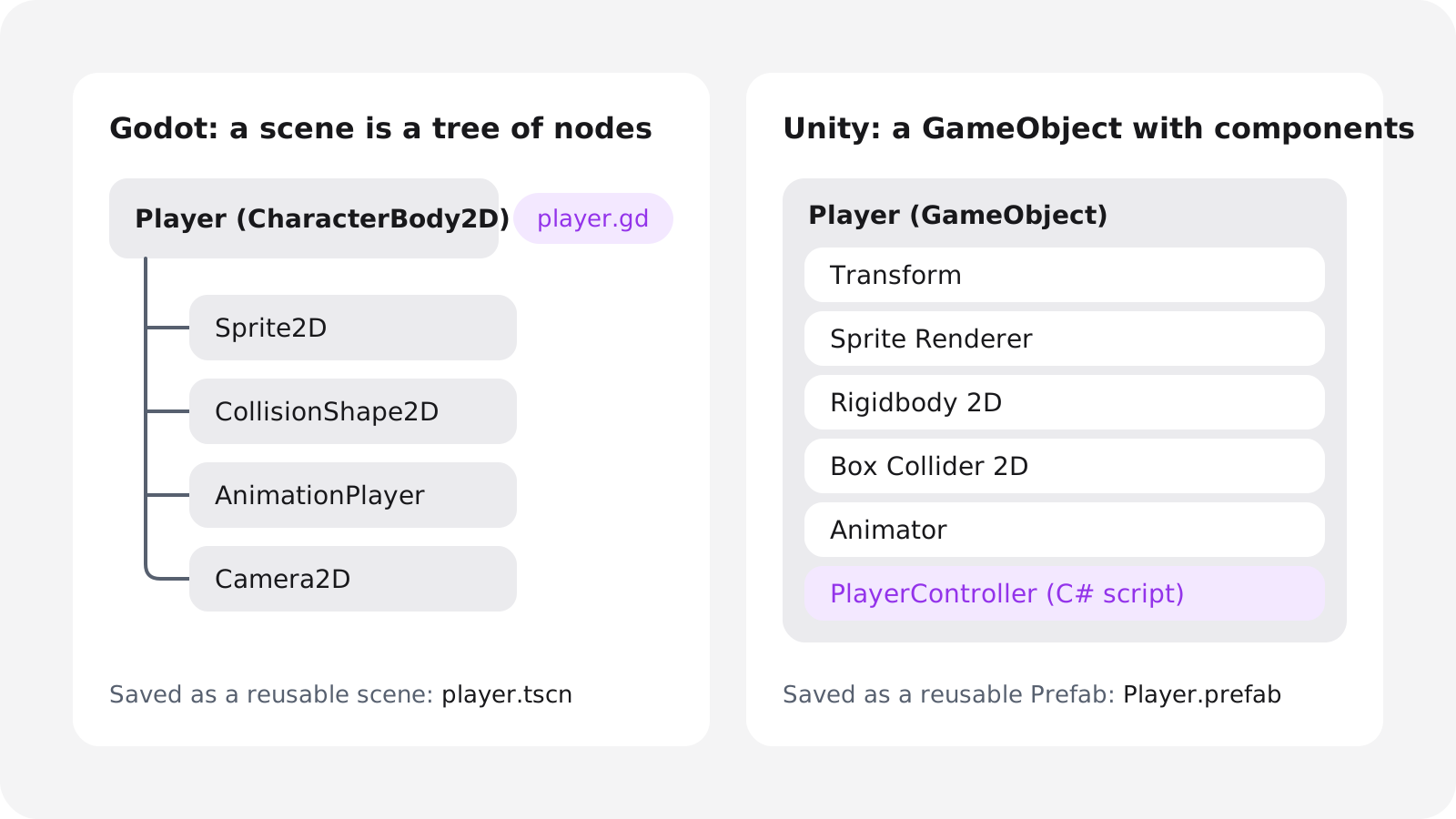
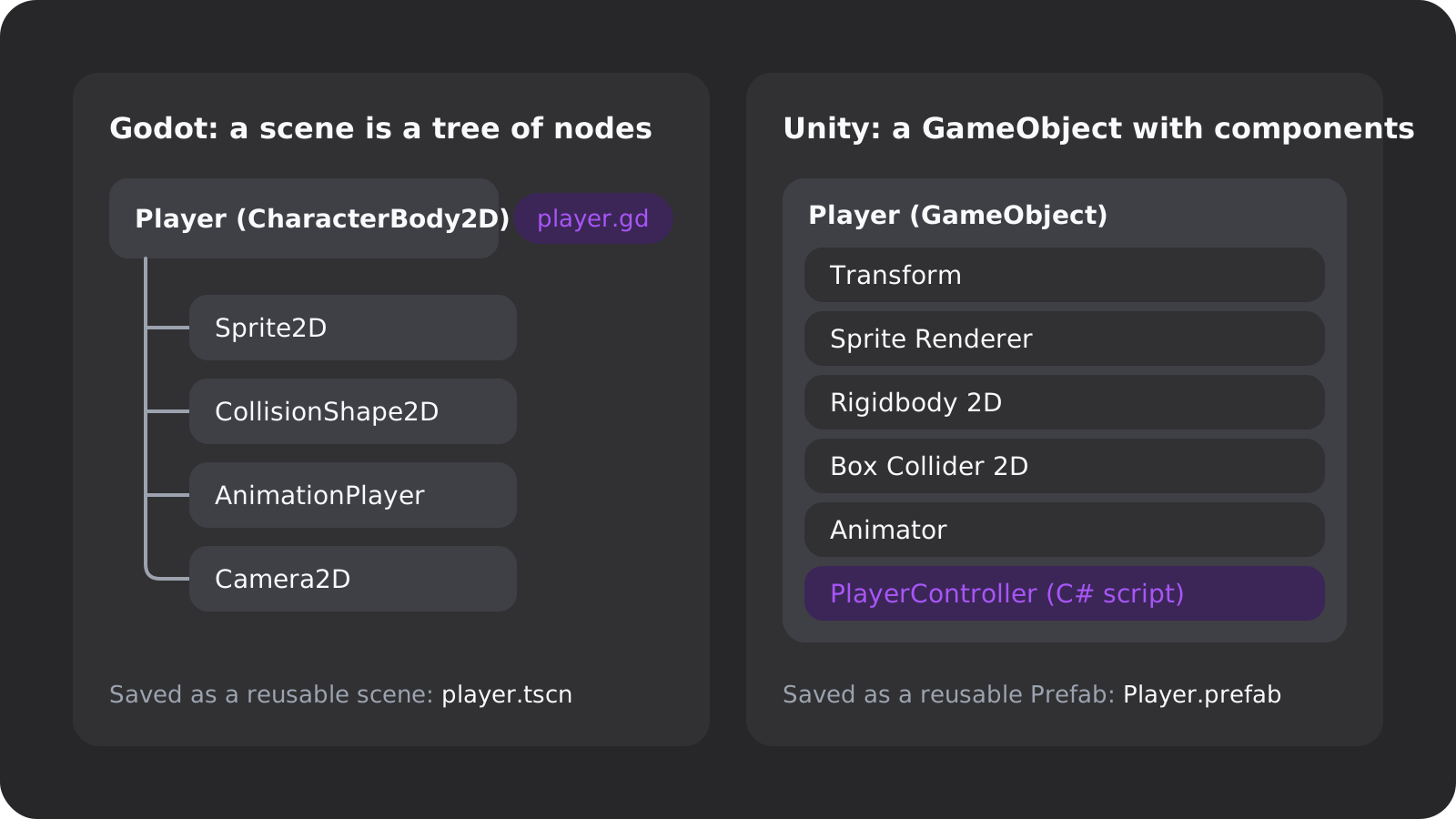
Neither model is better. Godot's is easier to read at a glance, because the scene tree shows you every part. Unity's keeps everything about an object on one GameObject. Switching in either direction feels backwards for a while.
Setup, tutorials and version traps
Check the date on every tutorial. Anything from before Godot 4.0 (1 March 2023) describes an older engine. Many older Unity tutorials use the Built-in render pipeline, which Unity deprecated in 6.5 and tells you not to use for new games.
Unity has made testing faster lately. New Unity 6.6 projects enter Play mode without a domain reload by default, so the wait each time you press Play is shorter (What's new in Unity 6.6). Godot's other sizes, for completeness: the .NET editor for Windows is 117 MB, and the export templates you download once before your first export are about 1.3 GB for all platforms.
2D games, 3D games and performance
2D: both are strong, Godot is simpler
Godot "offers dedicated 2D and 3D rendering engines", and "the base unit for 2D scenes is pixels" (Godot design philosophy). In practice, the numbers in the inspector match the pixels on screen, which makes pixel art and UI layout predictable. Godot 4.7 added a 2D scene painter and a built-in virtual joystick for touch games (Godot 4.7).
Unity's 2D is mature too. It runs on URP with 2D lights, and Unity 6.5 added custom 2D lights and shadows plus a 2D Profiler module (What's new in Unity 6.5). Hollow Knight: Silksong is a Unity game, and it sold over seven million copies by December 2025 (Wikipedia).
For 2D, choose on comfort and language, not capability. Beginners should take Godot. If your first idea is a jump-and-run, how to make a platformer covers jump feel, level design and scope.
Is Godot good for 3D?
Yes, with limits. Godot has three renderers: Forward+ for desktop, Mobile, and Compatibility, the one used on the web (Godot web export docs). The last two years closed a lot of the gap. Godot 4.6 made Jolt the default physics engine for new 3D projects and overhauled screen-space reflections (Godot 4.6). 4.7 added rectangular area lights and HDR output, and the 4.8 beta brings texture streaming and screen-space contact shadows (Godot 4.8 beta 1). Road to Vostok is a 2026 3D game that switched from Unity to Godot, and the user-content platform in Battlefield 6's Portal mode is built on Godot (Wikipedia).
Unity still wins for high-end 3D. It has more mature tooling, ECS in the core engine and a deeper market for assets and middleware. Its own render story is simpler than it was. URP is where Unity is "heavily investing", and HDRP gets no new features. The Built-in pipeline is deprecated but supported until at least the end of 2028 (Unity render pipeline strategy). Start every new Unity project on URP.
If photoreal 3D is the whole point, look at Unreal as well. In the GDC 2026 survey, 42% of developers named Unreal their primary engine and 30% named Unity. On Steam, the top 50 new Unreal games of the 12 months before March 2026 grossed about $1.8B, against about $930M for the top 50 new Unity games (GameDiscoverCo).
If this is your first 3D project, keep it small in either engine. Cameras, lighting and collision all get harder in 3D. A short horror game set in a few dark rooms is forgiving, because darkness hides rough art and small spaces keep the level count down. See how to make a horror game for that route, or how to make a 3D game for the general process.
Performance: no fair benchmark exists
There's no neutral, sourced 2026 benchmark that runs the same game in both engines. Ignore headlines that crown a winner on frame rate without publishing their test. At beginner scale, your scripts, draw calls and art will limit performance long before the engine does.
Web, mobile, console and VR support
Web and browser games
Godot's web export is good, with one catch most comparisons miss. Official Godot 4.7 web builds use the Compatibility renderer on WebGL 2. Forward+ and Mobile don't run in the browser, and "Godot currently does not support WebGPU" (Godot web export docs). Single-threaded export has been the default since 4.3, so you don't need the special server headers that threaded builds require.
The catch is C#. C# projects can't export to the web at all. A prototype was shown at GodotCon Boston in May 2025, but maintainers "cannot commit to a specific timeline yet" (Godot Forum), and the 4.8 beta doesn't mention it. If the browser matters, write GDScript.
Unity is ahead on web features. WebGPU left experimental in Unity 6.6, and the WebGL player runtime got "significantly" smaller (What's new in Unity 6.6). For a jam game or a small browser game, Godot with GDScript is the easy choice. For demanding 3D in a browser, Unity has the edge today.
Mobile
Both engines ship to Android and iOS. Unity 6.3 supports Android 7.1 and later and iOS 15 and later. Unity says 70%+ of the top 1,000 mobile games are made with it (Unity mobile), a figure that is Unity's own and dates from Q4 2022. Discount it as a vendor claim and our view stays the same: for free-to-play with ads and in-app purchases, Unity is the safer default.
Godot has fixed a lot of mobile pain recently. 4.6 fixed Vulkan crashes on Mali and Adreno GPUs and added scrcpy mirroring for testing on Android. 4.7 made the Android build environment stable, so you can export from an Android device, and added iOS controller support through SDL3. For premium and simple mobile games, Godot is a solid choice. Our guide to making a mobile game covers the Apple and Google store accounts, fees and phone testing.
Consoles
Unity wins here, plainly. Unity 6.3 builds for Switch, Switch 2, PS4, PS5, Xbox Series X|S and Xbox One from the Windows editor, as long as you have Pro.
Godot can't ship console builds itself. The Godot Foundation "does not maintain official console ports" because console SDKs are closed, but approved developers ship through certified third parties (Godot consoles page). W4 Games, founded in 2022 by Juan Linietsky and other members of the Godot team, sells W4 Consoles for Switch, PS5 and Xbox Series. Switch 2 support is in beta, and so is C# on Switch and Xbox. Porting houses such as Lone Wolf Technology, Pineapple Works and RAWRLAB do full ports.
VR and XR
Unity covers more devices: Meta Quest, visionOS, HoloLens, Magic Leap 2, OpenXR and ARCore, with Apple Vision Pro builds on Pro only. Godot is a credible open option. It added OpenXR 1.1 in 4.6 and day-one Android XR and Steam Frame support in 4.7, and the 4.8 beta brings visionOS back with Vision Pro hand tracking.
| Target | Godot with GDScript | Godot with C# | Unity |
|---|---|---|---|
| Windows, macOS, Linux | Yes | Yes | Yes |
| Android | Yes | Experimental | Yes |
| iOS | Yes | Experimental | Yes |
| Web browser | Yes (WebGL 2) | No | Yes (WebGL 2, WebGPU) |
| Switch, PS5, Xbox Series | Third party | Third party (C# beta on Switch, Xbox) | Yes, with Pro |
| Meta Quest and OpenXR | Yes | Experimental (via Android) | Yes |
Sources: Godot C# docs, Godot web export docs, W4 Consoles, Unity 6.3 system requirements, Unity pricing.
Who uses Godot and Unity in 2026
Short version: Godot is winning new and small developers, and Unity still ships most commercial games.
Steam releases
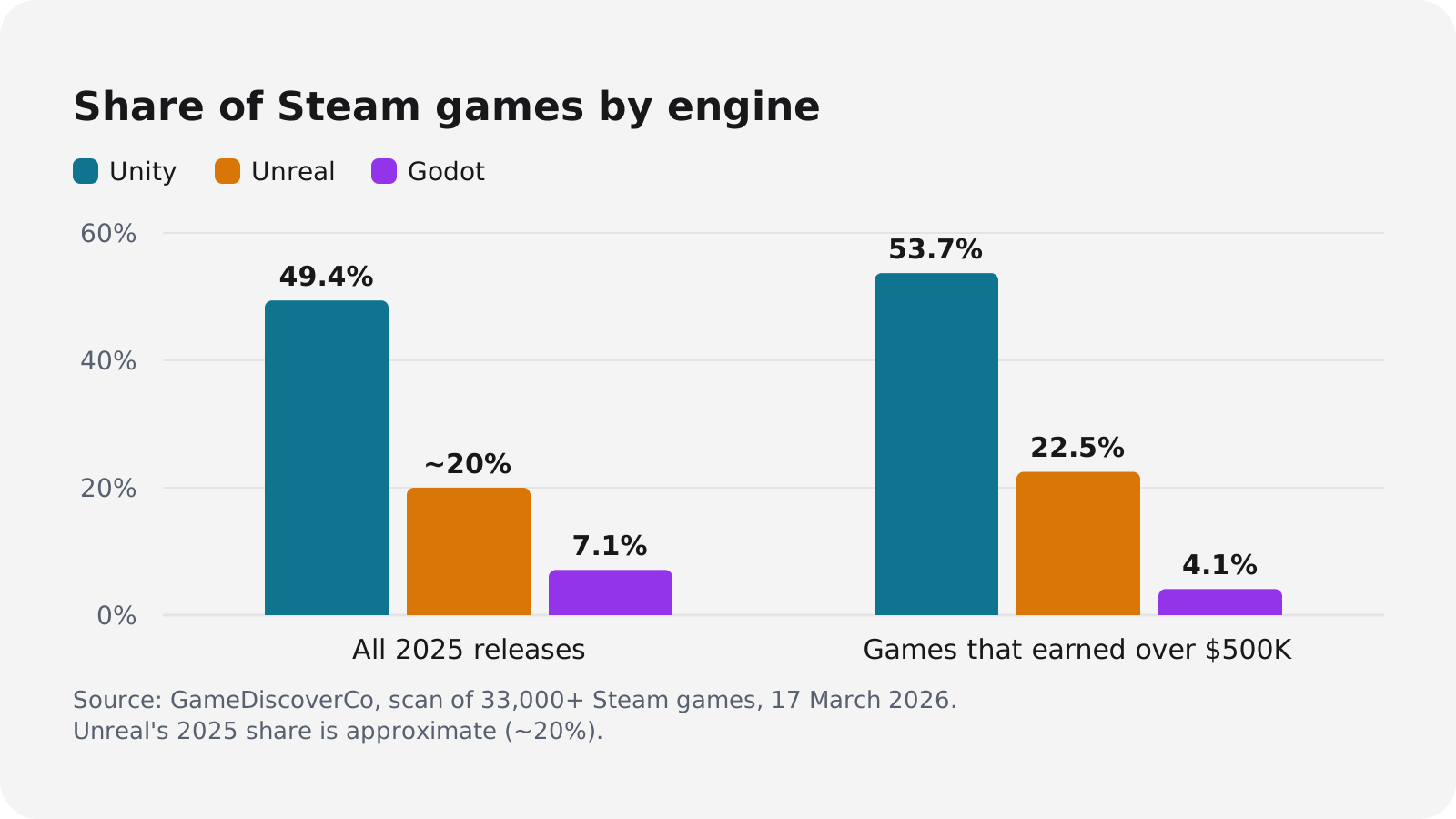
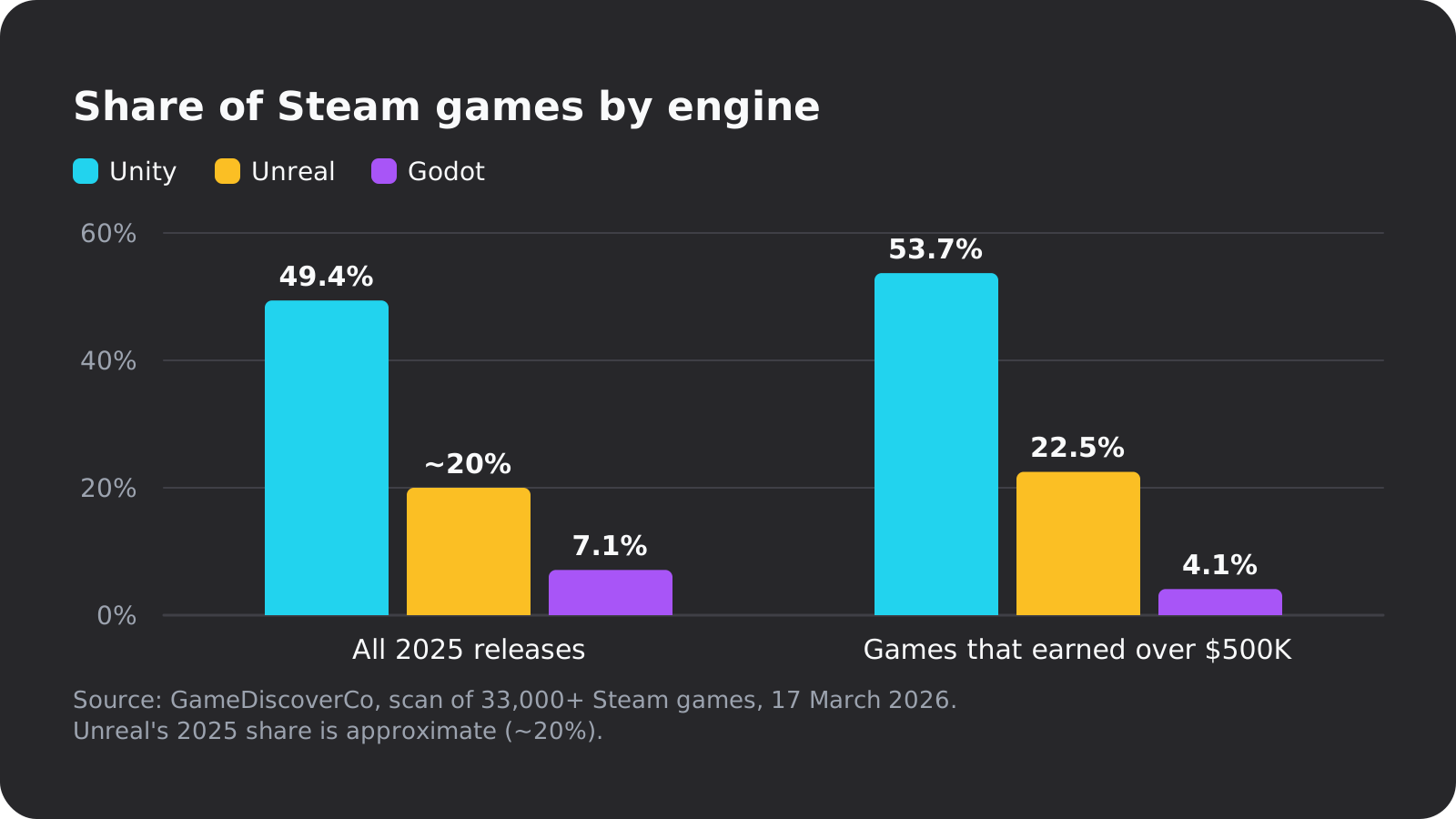
GameDiscoverCo scanned more than 33,000 Steam games for its March 2026 engine report (GameDiscoverCo). Unity has "regularly had 50-51%" of releases and had 49.4% in 2025. Godot grew from 0.9% of releases in 2020 to 7.1% in 2025, and it's 8.6% of the unreleased games in the scan, so the next few years should show more. Unreal went from 15% to about 20%.
Money tells a different story. Among games in the study that earned more than $500K, Unity has 53.7%, Unreal 22.5% and Godot 4.1%. The author calls the sample "not perfect", but the pattern is plain: lots of Godot games, few big earners so far. Brotato is the highest-grossing Godot game on Steam.
Game jams
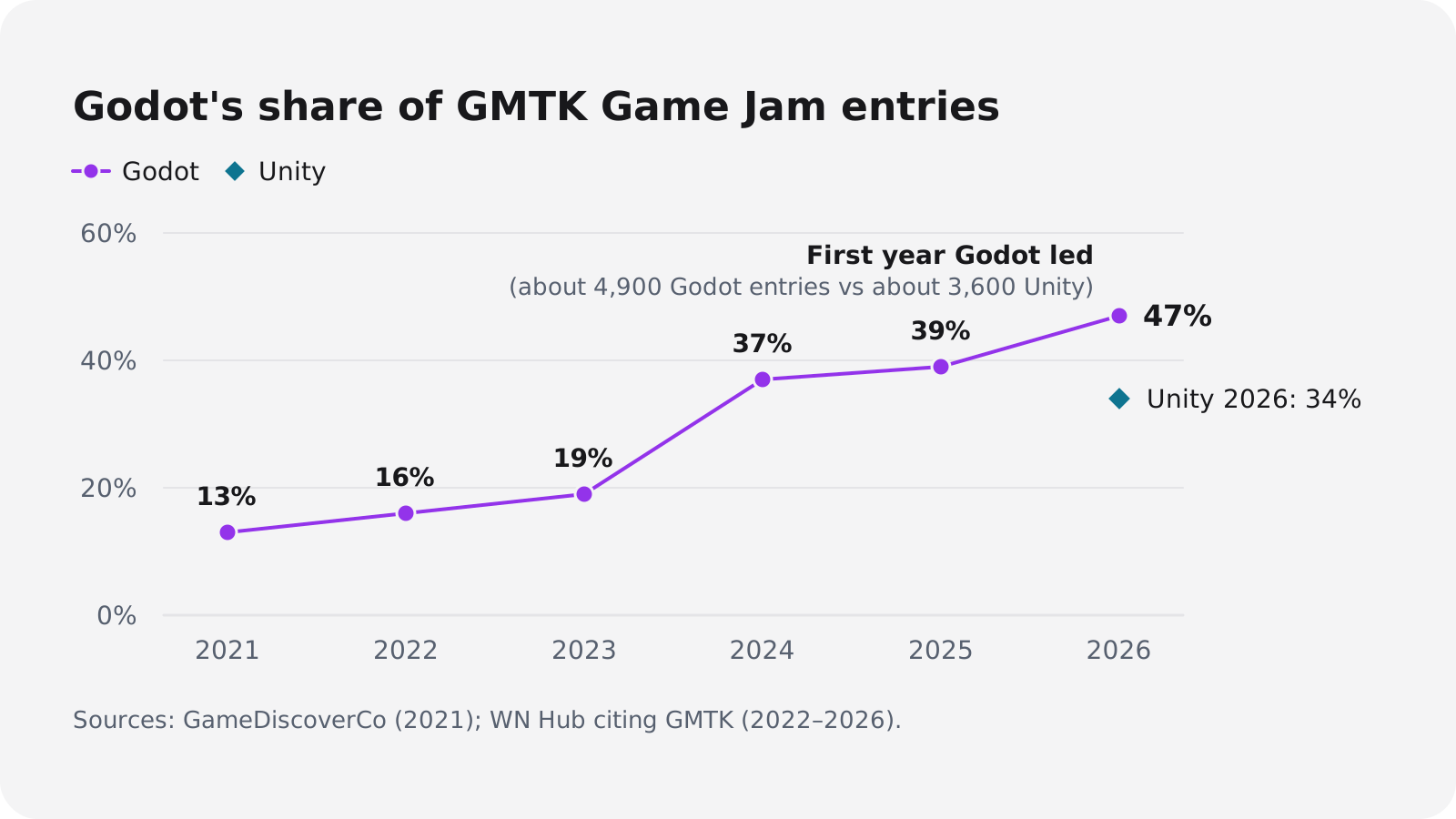
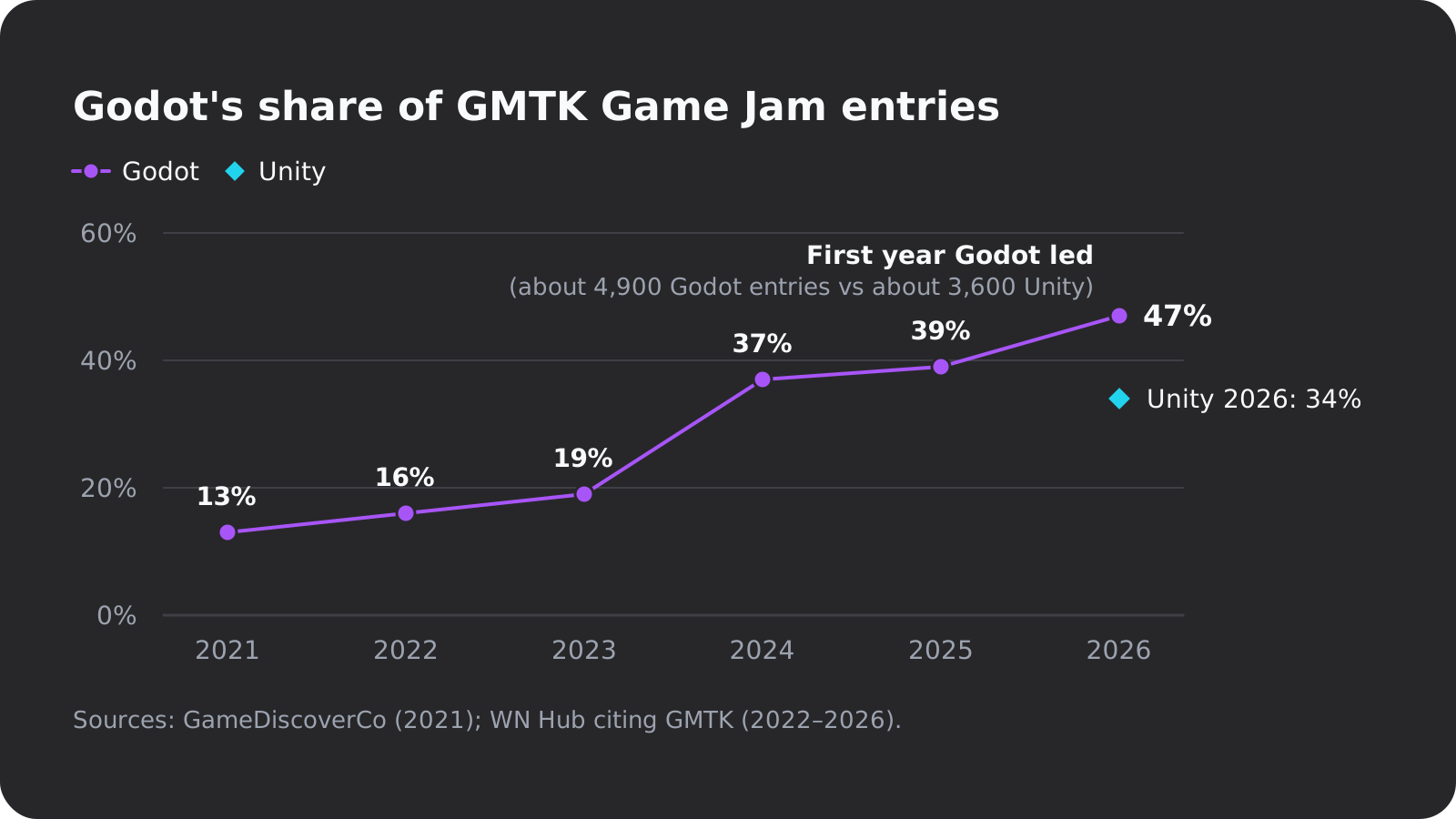
Game jams are where beginners and hobbyists show up, and the GMTK Game Jam drew roughly 10,000 entries in 2026. In July 2026, Godot made 47% of entries (about 4,900 games) against Unity's 34% (about 3,600), with GameMaker at 5% and Unreal at 3%. It was the first time Godot led, ending a nine-year run for Unity (WN Hub, citing GMTK). Godot's share before that: 13% in 2021 (per GameDiscoverCo), 16% in 2022, 19% in 2023, 37% in 2024 and 39% in 2025.
Godot's own numbers point the same way, with a caveat. Its growth report from May 2026 says each release gets about 2 million downloads and the community doubled in a couple of years. It also says growth "appears to be slowing down in the last year". Those figures are self-reported.
Studios, jobs and assets
The GDC 2026 survey skews toward larger studios, and that's where Unity's 30% primary-engine share comes from; GameDiscoverCo's summary of it gives no Godot figure. We found no reliable job-posting counts for either engine, so treat any page that quotes them with care. The direction is still clear: for a job at an existing studio, especially in mobile or XR, Unity and C# are the safer skills.
Unity's Asset Store has a long head start, and GameFromScratch calls it "the biggest asset store of all game engines" (GameFromScratch). Godot replaced its old Asset Library with a new Godot Asset Store in 4.7. It's still in beta, and the listings visible on 1 November 2026 were all free.
Games made with each engine
On the Godot side, Slay the Spire 2 sold 3 million copies in its first week of Early Access in March 2026 (GamingOnLinux). For the full picture, see our list of games made with Godot. Unity's list is longer and older: Pokémon Go, Monument Valley, Cuphead, Beat Saber and Call of Duty: Mobile are all Unity games.
Godot, Unity and AI game makers
Both ecosystems are moving toward "describe a game, get a game", from opposite directions.
Unity is building AI into the product. Unity AI, which gives contextual help and generates assets inside the editor, is in beta in 6.3 LTS (Unity 6 releases). Pro doubles Personal's 1,000 monthly AI credits to 2,000, and Personal lists "MCP and CLI access". Unity Studio, a browser-based version of the engine that isn't aimed at game developers, launched in March 2026. Unity Spark is a browser-based, AI-driven engine for non-developers, built with Google Playground and announced on 7 October 2026. It isn't broadly available yet and has no public pricing (GameFromScratch).
Godot has no official AI features. It gets them from third parties instead, which works because a Godot project is ordinary files on an open engine that any tool can read and write. The options for using AI with Godot range from Godot MCP servers that let an AI assistant drive the editor to full AI game makers.
Oryn is one of those tools. We publish this article and Oryn builds Godot projects, so weigh our view of Godot with that in mind. With Oryn's AI game maker, you describe a game, answer a few planning questions and approve a game design document. Oryn then builds a real Godot project and a playable web build in your browser; the build button says about 30 minutes. You keep changing it in chat. You can also export the full Godot project as a .zip that opens in the Godot editor, or as desktop, Android, iOS (Xcode) or Steam builds. Store accounts and submissions stay with you. Oryn projects currently use Godot 4.6.3, one feature release behind the 4.7.2 compared here. The free plan covers planning up to three games and building your first one; changing it or building more is covered by Oryn's paid plans.
How to choose in one weekend
Comparisons, this one included, only get you so far. The quickest way to decide is to build the same tiny thing in both engines.
Write the game down in five lines
Platform, 2D or 3D, genre, the one thing the player does most, and how big it is. A one-page game design document is plenty.
Check the hard constraints
Planning a console release: budget for Unity Pro or a Godot porting partner. Browser game in C#: not Godot, for now. Free-to-play mobile with ads: lean Unity. If none apply, keep going.
Install the stable versions
Godot 4.7.2 from godotengine.org, and Unity 6.3 LTS through Unity Hub with a URP project. Skip betas and alphas for a first project.
Build one mechanic in each, one evening apiece
A character that moves and jumps, or a card you can drag onto a target. Use one current tutorial per engine, made for the version you installed.
Keep the one you got stuck in less
Not the one that wins on paper. The engine you'll open again next week is the one you'll finish a game in.
Start tonight with step one: write those five lines, then download Godot 4.7.2 (86 MB on Windows) and Unity Hub, and give each engine one evening this weekend.
Frequently asked questions
Is Godot better than Unity?
Neither is better overall. Godot is free at any revenue and strong for beginners, 2D and web games, while Unity has more mature 3D, mobile and console tooling and made 49.4% of new Steam games in 2025.
Is Unity free?
Yes, if you qualify for Unity Personal: it's free when your revenue or funding over the past 12 months is under $200K, and the splash screen is optional. Above that, or for console builds, you need Unity Pro at $2,310 per seat per year or $210 per month, prices that apply from 12 January 2026.
Is Godot free?
Yes. Godot is open source under the MIT licence, with no fee, royalty or revenue cap at any size. Console ports are the exception, because they go through third parties such as W4 Games, from $800 a year per platform.
Is Godot or Unity better for beginners?
For most beginners, Godot. The Windows editor is an 86 MB download with a built-in script editor, and GDScript reads a lot like Python. Unity has more tutorials and teaches C#, which is the better pick if you want a job at a games studio.
Is Godot good for 3D?
Yes for stylised and mid-sized 3D. Godot 4.6 to 4.8 added Jolt physics, area lights, HDR output and texture streaming, and Road to Vostok is a 3D game that moved from Unity to Godot. For high-end 3D, Unity on URP or Unreal still has more mature tools.
What happened to the Unity Runtime Fee?
Unity announced it on 12 September 2023 and cancelled it on 12 September 2024, and it never applied to any game. The trust it cost is why many developers looked at Godot, and Godot overtook Unity at the 2026 GMTK Game Jam with 47% of entries against 34%.
Can I use C# in Godot?
Yes, with the separate .NET build of Godot. C# works on desktop, it's experimental on Android and iOS, and C# projects can't be exported to the web yet.
Should I learn Unity or Godot in 2026?
Learn Unity if you want a games-industry job or plan free-to-play mobile games, since 30% of developers in the GDC 2026 survey named it their primary engine. Learn Godot if you want to make and ship your own 2D, web or jam games for free.