To make a horror game, design for fear before fun. Take away the player's power, restrict what they can see or hear, and keep the threat half-hidden for as long as you can. Then shrink the scope to one location, one threat and one goal, and playtest it yourself at night with headphones.
Graphics matter less than you think. Restraint and scope matter more. Below are the documented lessons behind Amnesia, Outlast, Alien: Isolation, Dead Space and Iron Lung, turned into rules for any engine, plus tools, a build order, sounds you're allowed to use and a checklist for testing scares. New to making games at all? Start with how to make a video game.
What makes a horror game scary?
Fear in games comes less from monsters than from uncertainty and helplessness. Most techniques below pull one of four levers: what the player knows, what they can do, what they can sense, and when things happen. Each subsection ends with a rule you can use.
Ask "is it scary?" before "is it fun?"
Thomas Grip of Frictional Games, the studio behind Amnesia and SOMA, says a horror game's core question is whether it's scary, not whether it's fun (Game Developer, 2014). Weapon upgrades might make a game more fun, he argues, but they would destroy the horror.
Frictional plans each level on a simple sheet (events, lighting, intended mood, enemy density) and cuts what doesn't play. Finding the fear takes far longer than making a mechanic fun.
The rule: write the feeling you want in each area (unease, dread, panic, relief) before any mechanic, and cut mechanics that don't serve it.
Take the weapons away
At GDC Europe in 2011, Grip explained that armed players fight, and fighting weakens horror. Removing weapons made Penumbra scarier, so Amnesia kept that decision. Outlast went the same way in 2013: you can't attack at all, and you survive by hiding in lockers and under beds, sneaking through shadows and running.
The rule: give the player verbs that avoid the threat (hide, run, close a door, hold still), never verbs that beat it.
Limit one sense
Amnesia's darkness began as a cost saving. A three-person team with one artist wanted the dark itself to be the threat (Grip, 2014). Outlast leaves most of its asylum unlit, so you see through a camcorder's night vision, which drains batteries you have to scavenge. Iron Lung seals you in a one-person submarine with no windows. Your only view outside is a low-quality camera that takes still photos, and you steer by map and instruments.
The rule: restrict one sense, usually sight, and make the substitute cost battery, time or noise.
Hide the numbers and let players scare themselves
Amnesia's sanity fell when players saw monsters, witnessed horrors or stayed in the dark, and low sanity triggered screen pulsing, a grating sound and scripted scares. Balancing it was nearly impossible because it depended on exploration habits and even monitor brightness, so Frictional made it mostly ambient and hid the exact values. Many players feared insanity more after that change.
Grip also describes a dark, rustling house in Slender: The Arrival, where knowing the myth made him project fear onto ordinary sounds. His caveat: imagined fear wears off quickly, and empty rooms go stale.
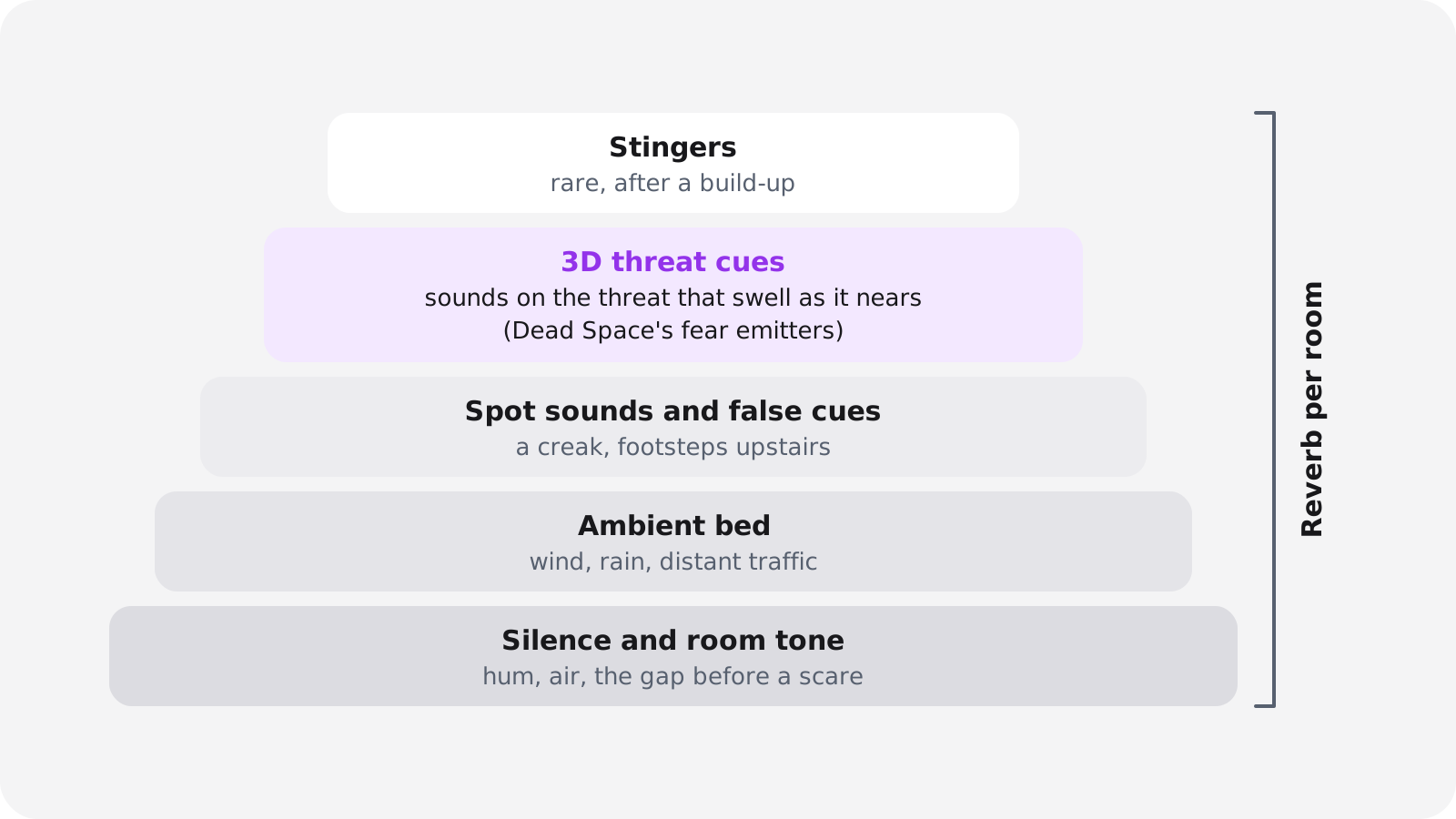
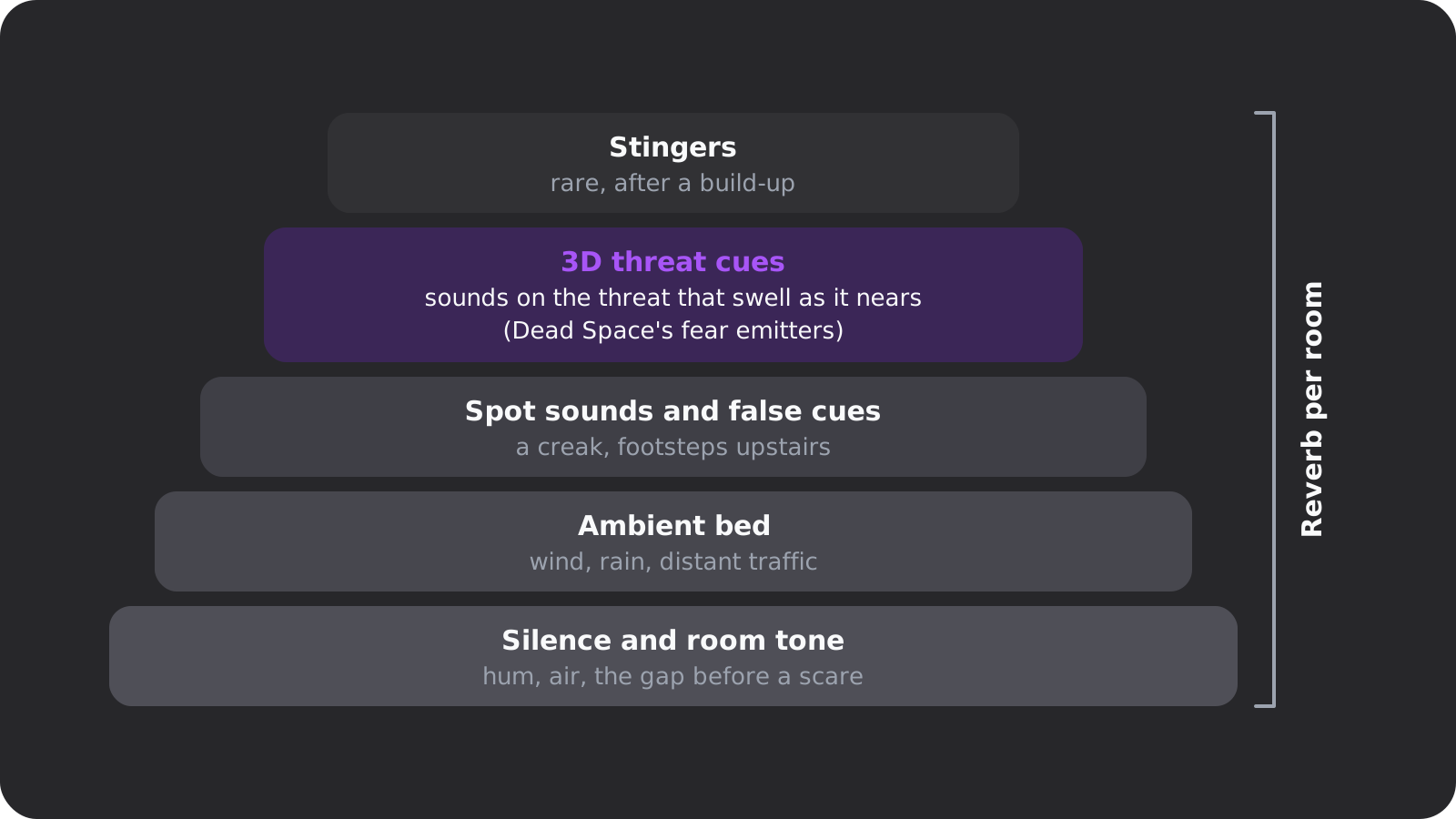
The rule: show danger through sound, screen effects and the world instead of a HUD bar, and put harmless false cues (a creak, footsteps upstairs) between real events, but never instead of them.
Build a stalker that's smart but not all-knowing
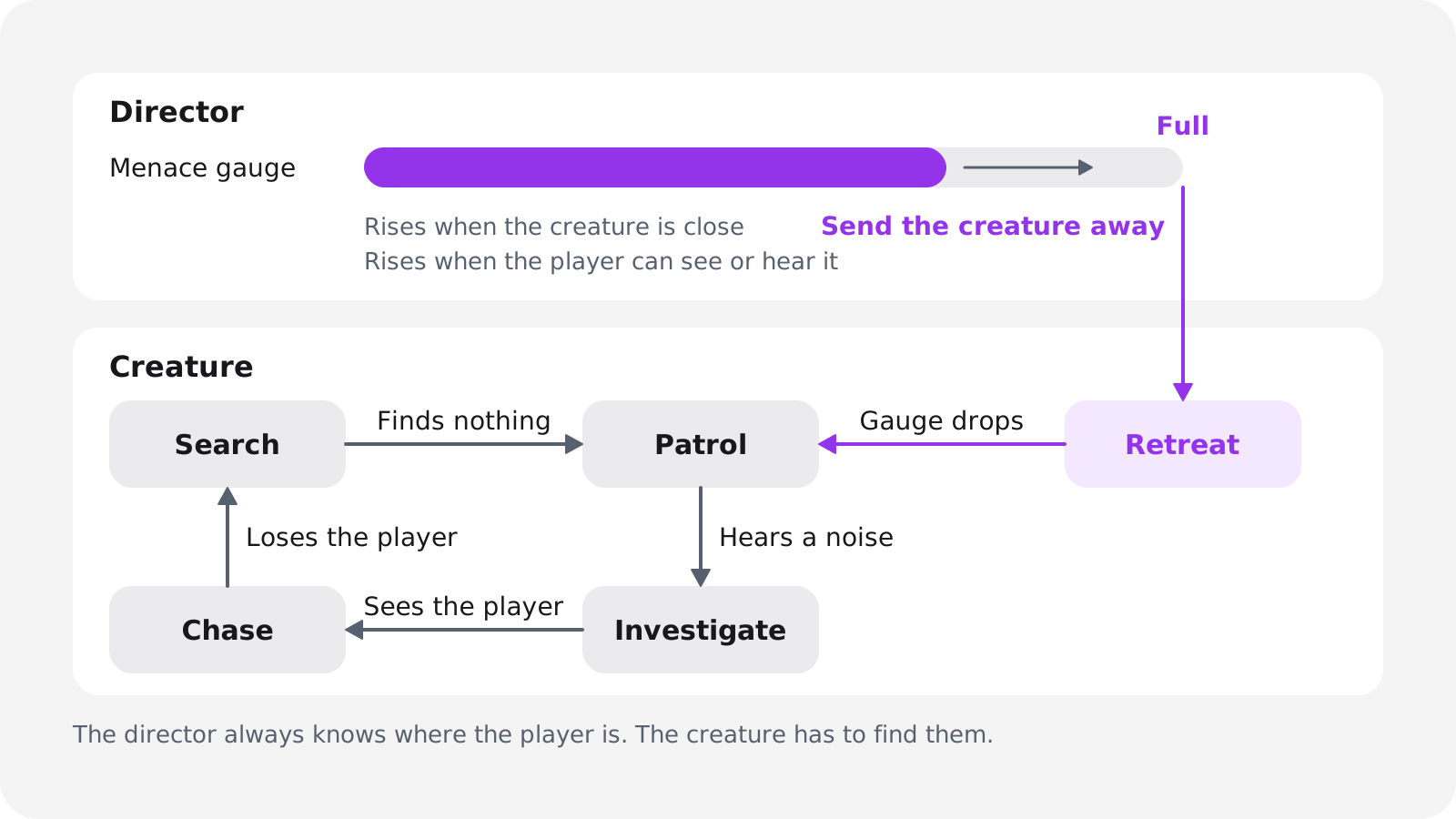
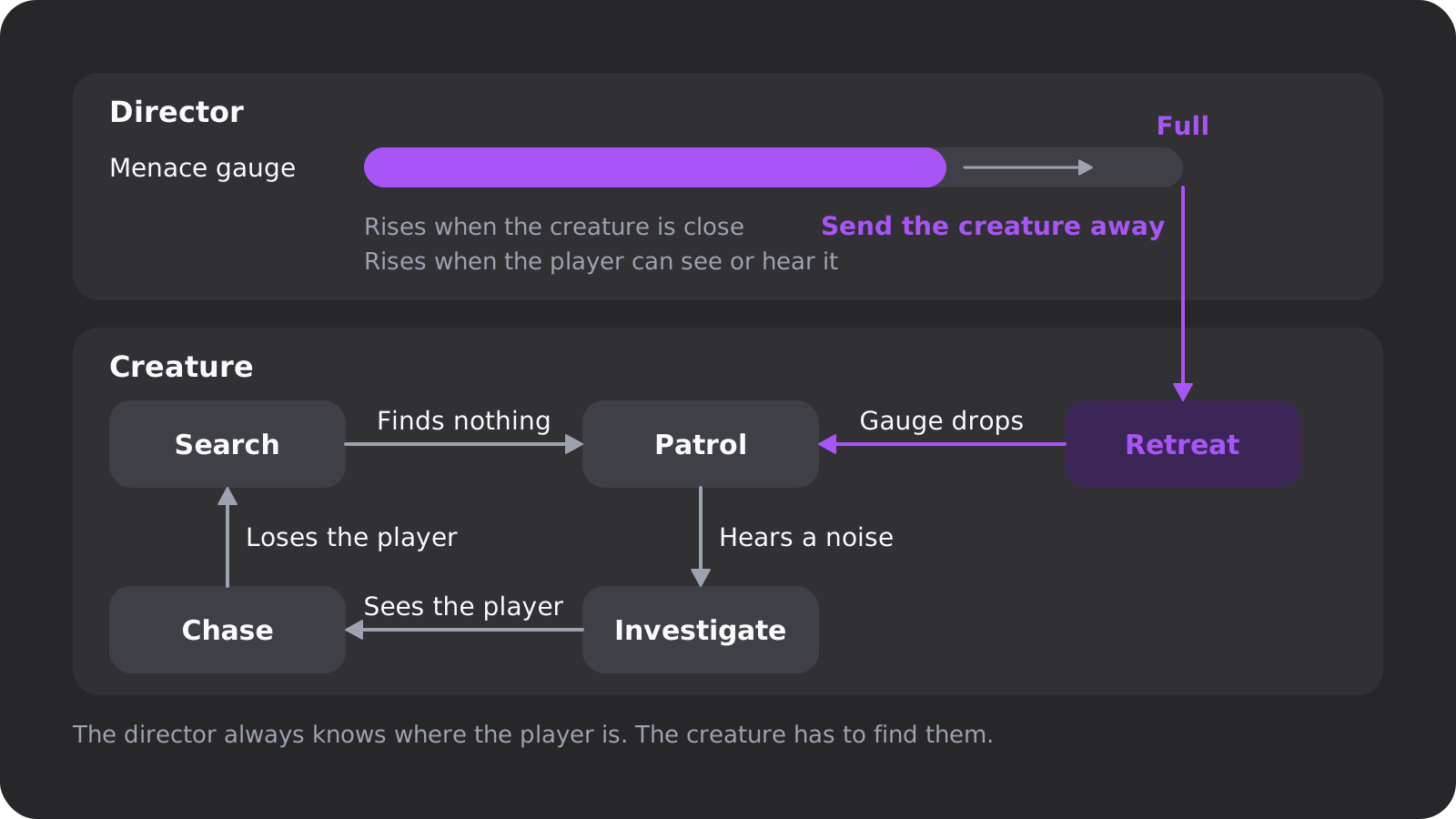
Alien: Isolation splits its creature into two AIs, as Tommy Thompson's analysis for Game Developer explains. A director tracks a "menace gauge" that rises the closer the alien gets and whenever the player can see or hear it. When the gauge peaks, the director pulls the alien away, to another area or into the vents. The director always knows where you are; the alien has to find you itself, which is why you can fool it.
Grip names the two ways a monster goes wrong. Too mechanical, and it becomes a gameplay object. Too unpredictable, and it confuses and annoys (Game Developer, 2015).
The rule: give your monster a few readable states and one pressure value that makes it back off before the player gets frustrated.
Let sound carry the fear
For Dead Space, audio director Don Veca placed invisible "fear emitters" in the levels and on every enemy (Designing Sound, 2009). Each emitter broadcasts an amount of fear that changes with the player's distance. The score was written as four layered stereo streams, mixed in real time by how much fear is being emitted, so players never got comfortable with a repeating loop (Game Informer, 2009).
The rule: put a 3D sound on every threat, drive your music layers from a single fear value, and use silence before big moments.
Don't turn death into a retry button
Frictional replaced Amnesia's game-over screen with a wake-up mechanic, because replaying a scene drains its impact and exposes the systems underneath. Grip made the same point about Alien: Isolation: once you die, the encounter stops being frightening and becomes a section to get past (DSOGaming).
The rule: when the player is caught, change the situation instead of reloading it. Wake them somewhere else, take an item, move the threat.
Save the reveal
Grip treats the first full view of a monster as a core story moment, too valuable to spend in a cutscene. Before that, show signs: a sound behind a wall, damage, a shadow under a door.
The rule: let the player hear and track the threat for several minutes before they see it, and make the first clear look happen during play.
What small horror hits have in common
Recent small-team horror hits mostly share one shape: a single strange premise in a small space. These are the ones with verified numbers.
| Game | Team | Engine | Verified number | Lesson |
|---|---|---|---|---|
| Amnesia: The Dark Descent (2010) | Frictional, three-person core | Frictional's own (HPL) | 1.4M sold by Sept 2012, bundles included | Darkness, no weapons |
| Outlast (2013) | Red Barrels, 10 people, 14 months | Unreal Engine 3 | Series at 15M units by 2018 | One building, a camera, no combat |
| Iron Lung (2022) | David Szymanski, solo | Unity | 2026 film grossed $51.2M worldwide | One room, one sensor, one goal |
| Lethal Company (2023) | Zeekerss, solo | Unity | 240,817 peak concurrent players, Dec 2023 | Co-op chaos around one loop |
| Buckshot Roulette (2024 on Steam) | Mike Klubnika | Godot | 8M copies by Dec 2025 | One table, one rule set |
| R.E.P.O. (2025) | semiwork, Sweden | Unity | 271,571 peak concurrent players, Mar 2025 | Physics comedy plus extraction |
Read the lesson column, not the sales column. Iron Lung and Buckshot Roulette each fit in one room, Outlast in one building, and the co-op hits repeat a single loop. Buckshot Roulette, the standout among games made with Godot, passed a million Steam sales less than two weeks after its Steam release (Game Developer).
Mouthwashing, credited to about seven people at Wrong Organ, passed 500,000 copies by February 2025 (Game Developer). Its publisher, Critical Reflex, also put out Buckshot Roulette and No, I'm Not a Human: short, odd, single-premise horror has a market. These are famous outliers, though. Most small horror games sell far less, so study them for scope, not revenue.
Scope it: one location, one threat, one goal
Your first horror game should fit on an index card. Here's one, filled in:
- Location: a closed gas station at night
- Threat: something outside that hunts by sound
- Goal: find three fuses, restart the generator, drive away
Hiding spots: the storeroom, under the counter, the walk-in cooler. Safe room: the lit office, which the creature can't enter. Getting caught: you wake in the storeroom and lose a fuse.
Aim for 10 to 20 minutes of play. That's a rule of thumb, not a law, but it's long enough for a full tension arc and short enough to finish and test many times. Put the card at the top of a one-page game design document and check every new idea against it.
Plan the tension curve
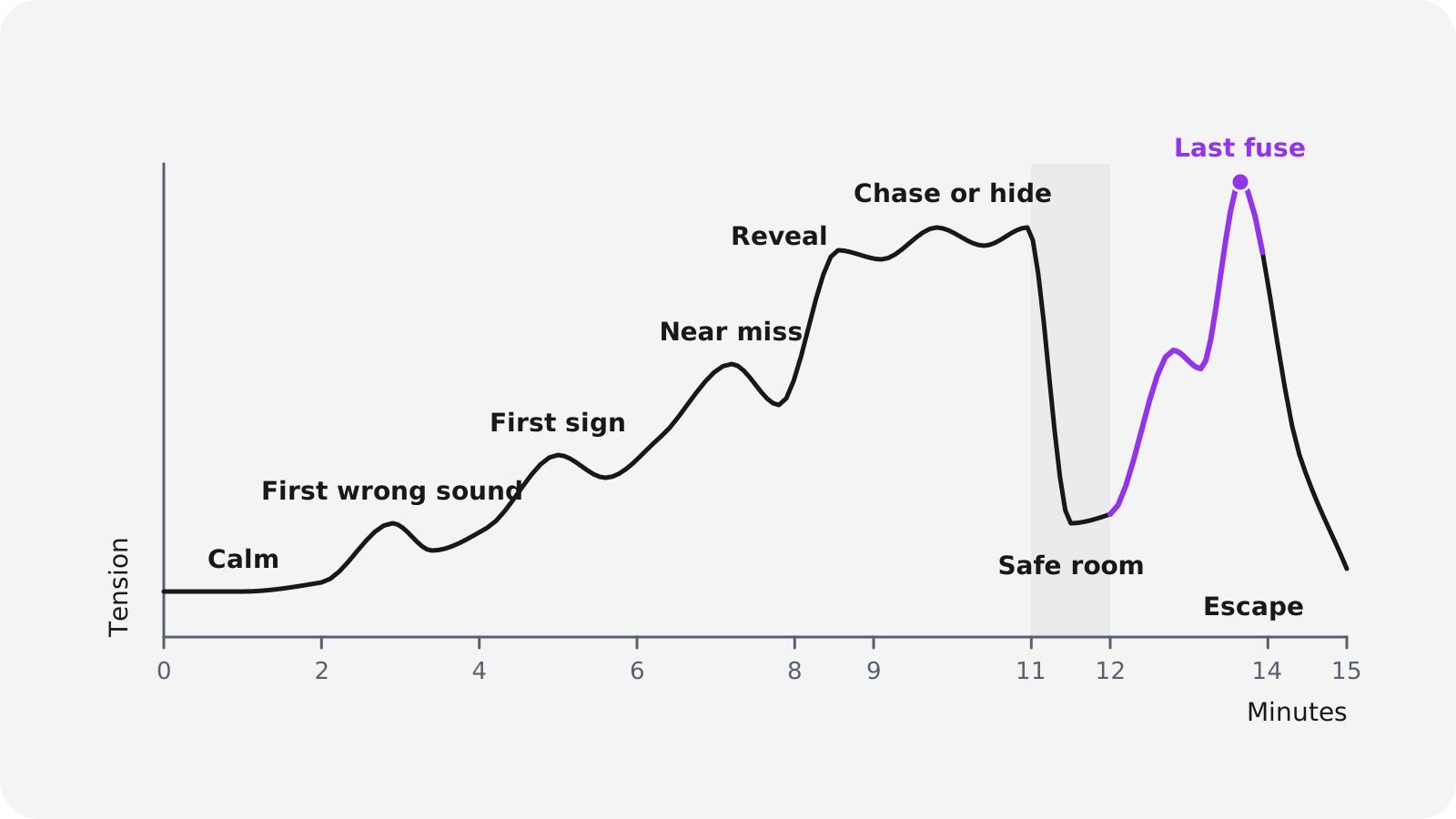
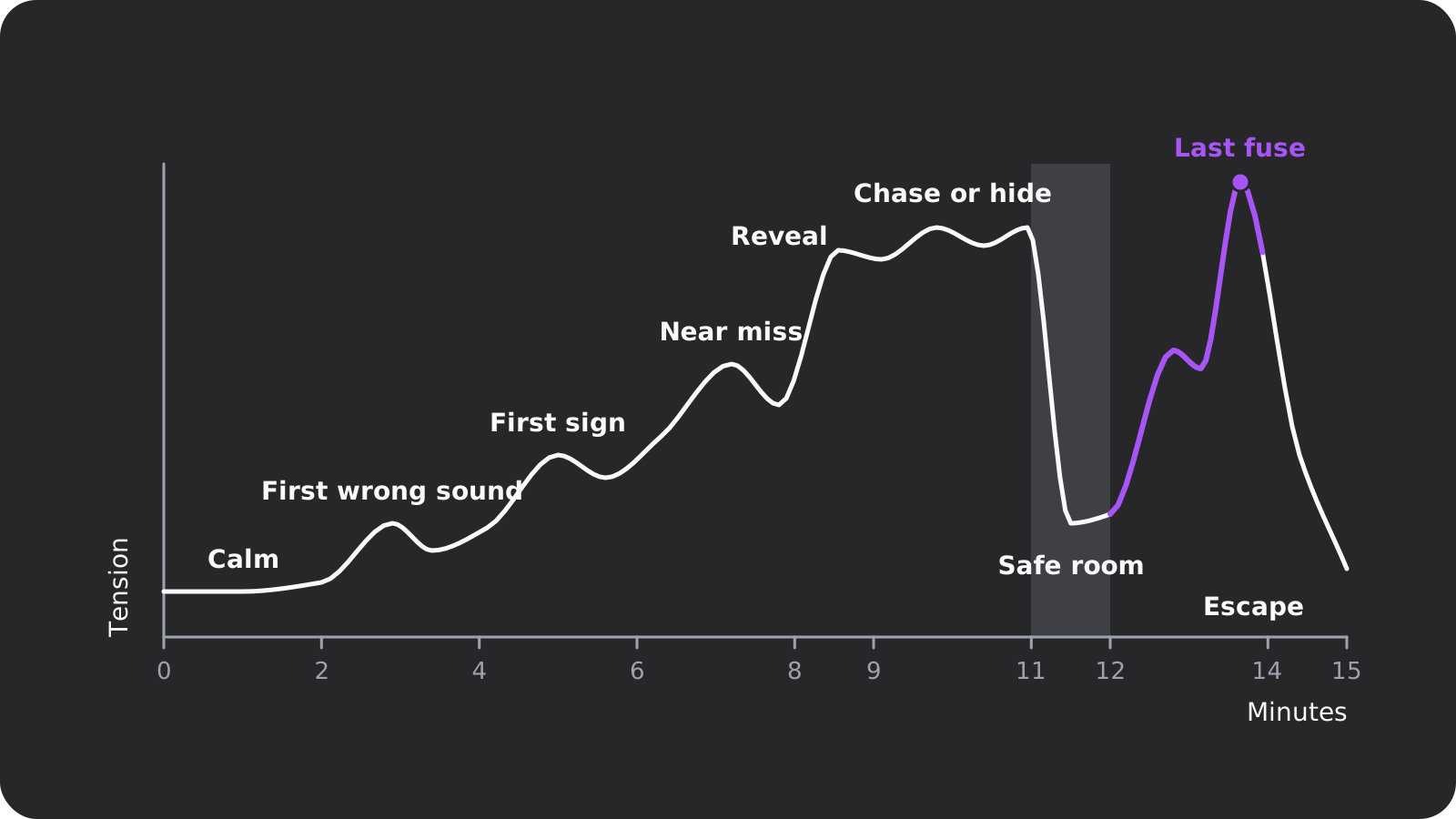
Fear works in waves: build, spike, release, then build higher. The safe room is where the release happens. Here's a rule-of-thumb beat sheet for a 15-minute game:
| Minutes | Beat | The player should feel |
|---|---|---|
| 0–2 | Calm; learn the controls | Curious |
| 2–4 | First wrong sound | Uneasy |
| 4–6 | First sign: footprints, an open door | Watched |
| 6–8 | Near miss: heard, not seen | Tense |
| 8–9 | A brief reveal | Shocked |
| 9–11 | Chase or hide | Panicked |
| 11–12 | Safe room | Relieved |
| 12–14 | Last fuse, under pressure | Cornered |
| 14–15 | Escape | Free |
Horror game ideas that fit the recipe
Each of these is a location, a threat and a goal. Steal one, or swap a single part.
- Laundromat, 3 a.m.: something moves only when you aren't looking. Finish your laundry and leave.
- The last bus home: the only other passenger sits one row closer every time the lights flicker. Reach your stop.
- A frozen research hut: the radio answers in your own voice. Fix the antenna and call for rescue.
- A parking garage after closing: the security monitors show someone you can't find. Reach your car on level 5.
- A stuck elevator: the display counts toward floors that don't exist. Pry the doors open before it stops.
- A children's play center at night: the costumed mascot is still on shift. Collect five dropped tokens and get out.
Pick a horror game maker or engine
Any of the big three engines can make a scary game. Pick the one you'll finish in, not the one with the prettiest trailers.
Free · MIT license
Godot 4
- Volumetric fog and FogVolumes (Forward+ only)
- PS1-style shader add-ons
- Made Buckshot Roulette
- Web export: Compatibility renderer only
Engine of many recent hits
Unity
- Lethal Company, R.E.P.O., Iron Lung, Fears to Fathom
- A huge base of tutorials
- Check the current plan terms yourself
Survival Horror template
Unreal Engine 5.6
- Template variant (June 2025) with moody lighting, stamina and sprint
- Build without code in Blueprints
- Heavy for a first project on a modest PC, in our view
Paid · 2D
RPG Maker
- No code, made for story-driven 2D
- Look Outside (2025) was built with it
- Top-down 2D only
Free
Roblox Studio and Scratch
- Popular with younger makers
- Lethal Company's developer began on Roblox
- Your game stays on the platform
Free tiers · credits vary
AI game makers
- Describe the game, play a build
- Ownership and export differ a lot
- Check asset licenses before you sell
Stuck between the two most common picks? Godot vs Unity compares them in depth.
Choosing a 3D horror game maker
Most horror is first-person 3D, and that's where engine limits show. Godot's volumetric fog works only in the Forward+ renderer, not in Mobile or Compatibility (Godot docs, version 4.7 as of November 2026). There it's a strong tool: FogVolume boxes, cones or ellipsoids add fog locally, negative density carves it out, and each light has its own Volumetric Fog Energy setting.
The catch is the browser. Godot's web export supports only the Compatibility renderer and needs WebGL 2 (Exporting for the Web), so browser horror relies on regular depth fog, fog sprites, darkness and a good flashlight. If you want volumetric fog, ship it in a desktop build and keep plain fog for the web.
Audio has a similar trap. Since Godot 4.3, the default web audio mode, Sample playback, has no reverb or other audio effects. Switch to Stream playback, project-wide or per node, if your scares need reverb, at some cost in latency.
RPG Maker horror games
RPG Maker is still the classic no-code route into 2D story horror. Look Outside, a survival-horror RPG by solo developer Francis Coulombe, came out on Steam in March 2025 through Devolver Digital, with console releases in late October 2026. The rules above work from a top-down view too: shrink the light radius, keep stats vague, skip weapons that make the player strong. The trade-off is that you're tied to the 2D, top-down style.
AI horror game makers
Several AI tools now pitch themselves as horror game makers. Rosebud runs in the browser on Three.js, with no code. Summer Engine is a desktop engine compatible with Godot 4 that exports to Windows and macOS; its hosted AI needs paid credits, and its horror page lists no prices (as of November 2026). Seele AI says it makes prototypes in 2 to 5 minutes, which is the vendor's own claim. Gamable and Yahaha offer a no-code horror maker and a horror template.
Before you commit, check four things: a real engine project you can open without the service, export to desktop or phones, play in a browser, and the license on generated assets. Our best AI game makers roundup compares the field on those points.
Making a horror game in Oryn
Oryn is the AI game maker we build. You describe the game, Oryn asks planning questions one at a time (art style included) and writes a game design document you approve before anything is built. Then it builds a real Godot 4 project and a web build you play in the browser, and you change it by chat. Every working version is kept and can be restored. The first build is labeled at about 30 minutes, so it isn't instant.
Two caveats for horror. 3D games on Safari and phones run with simpler graphics, so check your darkness in Chrome on a computer and again on a phone. And AI output varies between runs, so you still playtest. Each game ships with a CREDITS.md listing the engine, the asset sources and what shipping requires, and some generation models are flagged for a commercial-use check.
On any plan, the full Godot project exports as a .zip that opens in Godot with no proprietary runtime. The free plan lets you design up to three games and have the first one built, with its own art and soundtrack; changing it afterwards or building another needs a paid plan. The guide to writing a game brief shows what makes a prompt work.
How to make a horror game, step by step
Build in this order, whatever tool you use.
Write the fear in one sentence
"Something is in the building and it can hear me." Check every later decision against that sentence.
Fill in the card
One location, one threat, one goal, 10 to 20 minutes long. If an idea needs a second location, it waits for the sequel.
Greybox the space
Build it from boxes first: loops so the player can circle away from the threat, a few hiding spots, sightlines that tease the next room, and one safe room. New to 3D? How to make a 3D game covers the basics.
Light it dark, then add a brightness screen
Keep ambient light low and give the player a flashlight with a battery (a SpotLight3D in Godot). Amnesia's balance depended even on monitor brightness, so add a calibration screen before the game starts.
Build the sound before the monster
Layer room tone, an ambient bed, false cues on random timers and reverb per room (in Godot, an Area3D can route the sound inside it to a reverb bus). The space should feel wrong before anything lives in it.
Add a stalker that's scary and fair
Give it states (patrol, investigate a noise, chase on sight, search where it lost you, retreat) and a menace value that rises as it gets closer or is seen or heard, forcing a retreat at the top. In Godot, NavigationAgent3D handles pathing and a RayCast3D checks line of sight.
Decide what getting caught costs
Lose a fuse and wake in the storeroom. Never reload the same scare: the threat stays mysterious when the player can't memorize the encounter.
Playtest, cut, ship
Run the checklist at the end of this guide, then cut whatever doesn't scare, as Frictional did with Amnesia. If it should run on phones, plan touch controls early; how to make a mobile game covers what changes.
How to make a PS1-style horror game
The PS1 look suits small horror for two reasons. Low-poly models and wobbly, low-resolution textures hide seams and leave gaps the player's imagination fills, and they're cheap to make. Solo developer Puppet Combo is known for this style; its Murder House pairs tank controls and early PS1 graphics with VHS distortion and 80s synth music (Wikipedia).
The look comes down to a handful of tricks, all shown in MenacingMecha's Godot 4 PSX demo:
- Vertex snapping: vertices jump to a coarse grid, so models jitter.
- Affine texture mapping: textures warp across large polygons.
- Limited color depth and dithering: fewer colors, with a dither pattern over the banding.
- Tiny textures: low resolution, with filtering and mipmaps turned off.
- Vertex colors and fog: baked fake lighting, and fog to hide the short draw distance.
You don't have to write the shaders. The PS1 / PSX Visuals GD4 Port on the Godot Asset Library is MIT-licensed (listed for Godot 4.1, updated January 2026), and Zorochase's Ultimate Retro Shader Collection adds PS1, Saturn and N64 looks under MIT. A useful side effect: this style already relies on plain distance fog, which is exactly what a browser build can do.
Free horror sound effects and the licenses that matter
A horror soundscape works in layers, and the quiet ones do most of the work.
Free doesn't mean free to sell. On Freesound, each sound carries its own license, and one of them rules out any game you charge for.
| Source | License | In a game you sell? | Credit needed? |
|---|---|---|---|
| Freesound, CC0 sounds | CC0 1.0 | Yes | No |
| Freesound, CC BY sounds | CC BY 4.0 | Yes | Yes |
| Freesound, CC BY-NC sounds | CC BY-NC 4.0 | No, unless the creator agrees | Yes |
| Freesound, Sampling+ sounds (legacy) | Sampling+ 1.0 | Effectively no | Yes |
| Sonniss GDC 2026 Game Audio Bundle | Royalty-free | Yes | No |
Credit CC BY sounds the way the FAQ shows: the sound's name, the username with a link, and "licensed under CC BY 4.0". Filter searches by license before you download, and keep a text file of each sound's source, license and credit line. Freesound also lists your downloads on your attribution page.
The Sonniss GDC 2026 Game Audio Bundle is free, royalty-free and needs no attribution: 347-plus WAV files, 7.47 GB. Terms for earlier Sonniss bundles barred using the files to train AI models, so read the current ones if that matters to you. If a tool generates your sounds, the license depends on the model behind it, so check before you sell.
For binaural (HRTF) spatial audio, Valve's Steam Audio went fully open source under Apache 2.0 in February 2024 (FOSS Force). Godot only has an unofficial, alpha-stage community plugin for it, so treat it as an experiment.
Playtest checklist for scares
Fear is subconscious, so testers struggle to describe it. Frictional tests by playing late at night themselves, and Grip's advice is blunt: "You have to play it yourself." Then watch other people play instead of asking how scary it was. The numbers below are rules of thumb, not research.
- Yourself first: play at night with headphones, as if you'd never seen it.
- Watch, don't ask: note where testers stop moving, back away, hesitate at doors or laugh. A laugh usually means a scare deflated.
- First unease: under about 3 minutes (rule of thumb).
- Sightings: more than about 3 full views of the threat in 15 minutes risks overexposure (rule of thumb).
- Deaths per area: repeated deaths in one spot mean trial and error, and the fear is gone.
- Goal: did they understand it without a HUD prompt?
- Sound: did they notice the key cues on speakers and on headphones? In a browser build, does the reverb play?
- Brightness: can they see the path on a dim laptop screen?
- Fairness: could they explain how they got caught, without being able to predict the monster exactly?
- Safe room: did it feel safe?
- Comfort: did any camera shake or distortion make someone queasy? Frictional toned Amnesia's distortion down so players wouldn't feel ill.
- Phones: if it runs there, is it playable with touch controls?
Start tonight: write your one-sentence fear and your location, threat and goal card, then greybox the location in the tool you picked. Leave the monster out until the dark, empty space already sounds wrong.
Frequently asked questions
What makes a horror game scary?
Uncertainty and vulnerability more than monsters. Frictional Games removed weapons because armed players fight back instead of feeling afraid, and hid exact values like sanity so players imagine the worst.
What is the best engine for a horror game?
Any of the big three works. Many recent indie horror hits used Unity, Buckshot Roulette was made in Godot and reached 8 million copies by December 2025, and Unreal Engine 5.6 includes a Survival Horror template.
Is Godot good for horror games?
Yes. It has volumetric fog with local FogVolumes in the Forward+ renderer, plus PS1-style shader add-ons. Its web export uses the Compatibility renderer, so browser builds rely on regular fog and lighting instead.
Can I make a horror game without coding?
Yes. RPG Maker handles 2D story horror without code, Unreal's Survival Horror template works with Blueprints, and AI game makers such as Oryn turn a written description into a playable Godot project.
How long does it take to make a horror game?
It depends on scope. Outlast took a team of 10 about 14 months. A first project should aim for one location, one threat, one goal and 10 to 20 minutes of play, a rule of thumb that keeps it finishable.
Where can I get free horror sound effects?
Freesound and the free Sonniss GDC Game Audio Bundle. On Freesound, CC0 and CC BY sounds can go in a game you sell (credit the CC BY ones), but CC BY-NC sounds cannot without the creator's permission.
Do I need jump scares?
No. Amnesia built its fear from darkness, sound and hidden information. If you use jump scares, set them up and space them out; that's design consensus rather than a proven rule.
Can a small horror game succeed?
Some have. Iron Lung, made by one developer, became a 2026 film that grossed $51.2 million worldwide, and Mouthwashing passed 500,000 copies. These are outliers, so plan around finishing the game, not its sales.