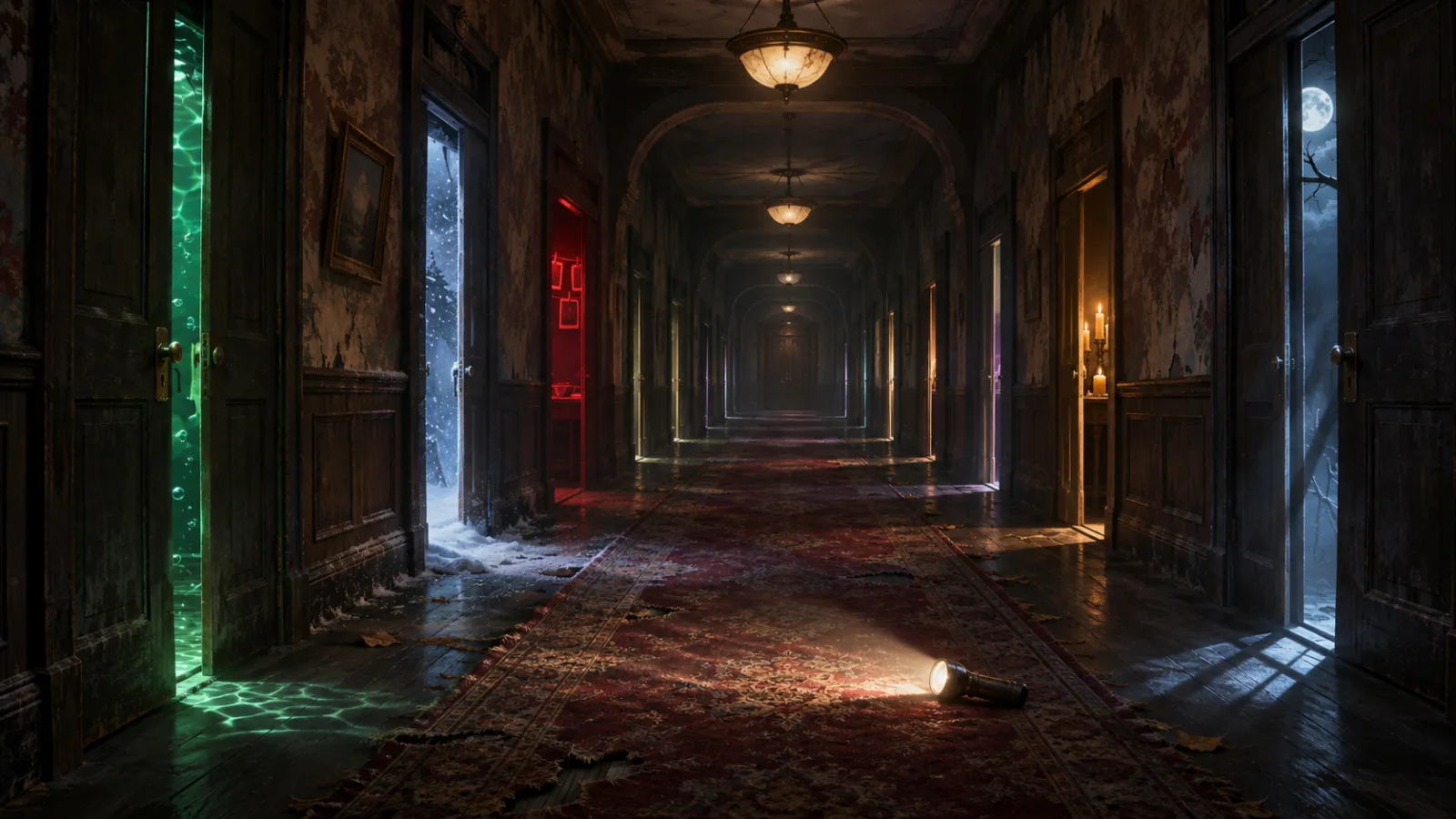
A horror game idea works when one clear rule makes an action the player needs dangerous, and hides one thing they want to know. "An abandoned hospital" is only a setting. "It can cross only clear floor, so every wardrobe you push opens or closes its path" is a game.
Each of the 20 horror game ideas below has one scary mechanic, a way to escalate or end, and a first build. One idea per group comes with a prompt for Oryn, the AI game maker we build, but all of them work in any engine. We wrote them for this page. The names are working titles, so search for one before you publish under it.
How to tell a horror idea from a setting
Run any idea through four questions:
- What does the player do every ten seconds? "Explore" is too vague. "Strike a match" is an answer.
- Why is that dangerous? The action they need should also expose them.
- What can't they know? Where it is, when it moves, or whether the screen is true.
- What gets worse? Name the change between minute one and minute ten.
Then swap the place. If your hospital idea still frightens you in a garden center, keep it. The Exit 8 is a well-known short example. Its Steam page describes one endless underground passage and one rule: turn back if you find an anomaly, keep going if you don't.
Atmosphere alone won't carry you. Thomas Grip of Frictional Games describes how players scare themselves in an unsettling space, but says the effect fades and empty places get old.
Flipped roles: you are the monster or the ghost
1. Polite Haunting
You're the ghost of a family house, and something worse sleeps in the cellar. It feeds on fear. Scare the family too little and they stay; scare them too much and it climbs one more step.
- Escalation: one child stops being afraid of you and starts to follow you.
- First build: five rooms, three family members, six small scares, a cellar stair with ten steps.
2. Bad Reflection
You live in a mirror and must copy a woman's movements exactly. Every mismatch makes her look closer. Something stands behind her, and the only way to warn her is to make a mistake on purpose.
- Ending: she understands and turns around, or she covers the mirror.
- First build: one bathroom, eight movements to copy, a suspicion meter, three warnings.
Mundane jobs and routines where something is off
A shift gives you a clock, a small space and a reason to stay.
3. Plow Route 9
You drive a snowplow on a mountain at night, and the radio asks you to open roads for stranded people. Anything can use a road you open. Fresh tracks in your own lane show that something already has.
- Ending: at dawn you drive back down the roads you chose and meet whoever used them.
- First build: one loop, three side roads, five radio calls, a fuel gauge.
4. Toll Booth Four
You write down how many people sit in each car that goes up the mountain. An hour later the same cars come back, and you lift the arm only if the count matches. Nobody inside has noticed the extra passenger.
- Escalation: windows fog, children duck, and one driver knows your name.
- First build: one booth, eight cars, a notebook, two buttons.
5. Lost Property
You run the lost property desk in an empty station. People describe an item and you hand it over or refuse. Then they begin to describe things nobody handed in, such as the photo in your wallet.
- Ending: the last visitor describes you.
- First build: one counter, twelve items, ten visitors, three impossible claims.
Places that turn against you
6. Clear Floor
Something walks your old house at night and can cross only clear floor. You push beds and bookcases to wall it out. Pushing is loud, and your own way to the front door has to stay open.
- Escalation: each night it learns to push one kind of furniture, starting with chairs.
- First build: four rooms, ten movable objects, one walker.
7. Low Tide Chapel
The thing in a chapel on a tidal flat moves only through water, so every puddle is a door. The tide rises while you search, and the dry stones you used a minute ago become its hallway.
- Ending: ring the bell for a boat and hold the last dry step.
- First build: a nave, two side rooms, five water levels, three things to find.
Psychological horror and shifting spaces
8. Left Turns Only
Every left turn adds a room to the house, every right turn removes one. A small house brings the exit close, but you share whatever rooms remain with the other guest.
- Escalation: it begins to take turns too, so rooms appear without you.
- First build: ten room pieces that snap together, a turn counter, one guest.
9. Yesterday's You
Each night lasts three minutes. The game records your path, and the next night a figure walks exactly that path. It must not see you, so a careless route makes tomorrow harder.
- Escalation: on night four, it does something you never did.
- First build: one house, path recording, a vision cone, four nights.
10. Witness Statement
A detective asks about a night you barely remember. Each answer is built into a house that you then walk through. Contradict yourself and the house gains a door that can't exist, with something behind it.
- Ending: the true version has the fewest doors, and nobody believes it.
- First build: six questions, one modular house, two versions of each room.
11. Margin Notes
The halls of a dark clinic look alike, so you rely on short notes you write on the map. Then a note has changed by one word.
- Escalation: some of the changed notes are right, and your original was wrong.
- First build: twelve rooms, player notes, three rewrites that happen out of sight.
Sound-based horror game ideas
Sound deserves its own group. A study of 102 films found more noisy screams in horror soundtracks than expected. A brain-imaging paper sums up earlier work in which people rated approaching sounds as more negative than receding ones.
12. Borrowed Sounds
Record the fridge on your tape and you can play its hum to cover your steps. But a recorded sound is gone from the world, and silence is what the thing follows.
- Escalation: you can record its footsteps. After that you never hear it coming.
- First build: one apartment, six recordable sounds, three tape slots, one listener.
13. The Piano Tuner
You tune a piano in a house that should be empty. The listener hears only pure notes, so out-of-tune strings hide you. The better you do your job, the more clearly it hears you.
- Ending: finish the last string and be paid, or leave it flat and walk out.
- First build: one room, twelve strings, a pitch dial, footsteps that answer each tuned note.
Camera and broadcast horror ideas
For tapes and emergency broadcasts, see our guide to analog horror games. In these two, the picture itself is the mechanic.
14. Weather at Eleven
You present the forecast in front of a green screen. Only the studio monitor shows the finished picture, and in it somebody stands on the map behind you. Look too long and you miss your lines.
- Escalation: it copies your gestures, then makes them first.
- First build: one studio, a prompter, one monitor, a three-minute forecast.
15. Slow Shutter
Your camera needs a four-second exposure, and whatever moves leaves no trace. So if a figure is sharp in your photo, it stood still the whole time, facing you.
- Escalation: later shots need eight seconds, and you have to stand still too.
- First build: one wood, six spots to photograph, a tray where pictures slowly appear.
Co-op horror game ideas
16. Blind Side
Two to four players search a flooded archive. The hunter is invisible to the player it's hunting and visible to everyone else. Your friends are your only warning, and they're busy.
- Escalation: it switches targets in the middle of a chase.
- First build: one floor, one hunter, a point-and-shout signal, five files to carry out.
17. Roped Party
Four climbers cross a glacier in a whiteout on one rope. You can't see or call each other, only tug: one for stop, two for go, three for help. Near the pass, the rope carries a fifth set of tugs.
- Ending: cut the rope in one place, then learn who was behind the knife.
- First build: one route, four rope positions, three signals, one extra set of tugs.
Small horror game ideas for a first project
For a two-week game, our rule of thumb is one space, one threat, one verb and about ten minutes of play. For a Roblox-sized game, keep the map just as small and turn it into short rounds: Clear Floor and Blind Side fit that shape.
18. Twelve Matches
One room, one door, twelve matches. Each match shows the room as it will be in one minute. If a figure stands beside the bed, you have a minute in the dark to be somewhere else.
- Ending: the twelfth match shows an empty room, without you in it.
- First build: one room, six hiding places, twelve lit states.
19. The Landing Light
A stairwell light runs on a timer. You climb fast only while it's lit, and so does the thing below. In the dark it stands still and you creep one step at a time.
- Escalation: the timer shortens, and a switch on another floor clicks by itself.
- First build: a 2D cutaway of eight floors, one button, one shadow.
20. Knock Back
Somebody knocks and you repeat the rhythm. Every correct answer adds a beat, and every mistake turns the handle a little. Through the peephole, the hall has one thing less each round.
- Ending: your own rhythm comes back from the wardrobe.
- First build: one door, one peephole view, a rhythm memory loop, ten rounds.
A finished example: Channel 6: Night Shift
Channel 6: Night Shift was made with Oryn and published by @nufect. We make Oryn, so read it as our own example. It contains AI-generated content, and its creator rated it 18+.
Its rule fits in one line: watch six monitors, compare each room with your notes and report what changed. Missed changes and wrong reports add noise, and too much noise ends the shift. A night takes about 10 to 12 minutes, the changes are drawn at random, and there are three endings. There's no blood and there are no weapons.
Channel 6 Night Shift
The four questions explain why it holds up. You compare rooms, six feeds compete for your attention, you don't know what will change, and later the broadcasts contradict each other and the phone rings.
Research supports the rule. Experiments by Rensink, O'Regan and Clark showed that even large, repeated changes become very hard to spot when a brief blank separates two versions of a picture. More games are on the games shelf.
How to turn an idea into a one-page plan
Fill in this table before you open any tool. Here it is for Twelve Matches.
| Line | Answer in one sentence |
|---|---|
| Rule | A match shows the room one minute ahead |
| Player actions | Strike, hide, move in the dark |
| Threat | A figure you see only in the future |
| Can't know | Whether it came early |
| Escalation | Hiding places break, one by one |
| Getting caught | You lose a match and wake by the door |
| Ending | The twelfth match shows nobody |
| Not included | Combat, inventory, a second room |
The last line matters most. Grow the table into a one-page game design document and write your request with the game brief guide. Our tutorial on how to make a horror game covers tension curves, stalker AI, engines and playtesting.
In Oryn you answer planning questions and approve a design document before anything is built. New games are TypeScript web projects that run in the browser. You can plan one game for free; building takes credits or a paid plan, and multiplayer rooms need a paid plan. The horror game maker page shows what gets made. Still undecided? Try the game idea generator.
Common mistakes with horror game ideas
- The setting does all the work. If your page describes wallpaper and no action, go back to the four questions.
- Too many clever rules. Furniture plus tape recorder plus rising water is three games. Keep one.
- Constant fear. Researchers who followed 110 visitors through a haunted house found that enjoyment peaked at a middle level of fear. Plan calm stretches.
- Too much shown. In Giovanni Caputo's mirror study, 50 people looked at their own face in low light, and most began to see strange faces in under a minute. Leave gaps.
- Unfair rules. Players should be able to say why they were caught.
- Sound as the only clue. Add a visual option for players who can't hear it.
Frequently asked questions
What makes a good horror game idea?
One rule that makes a necessary action dangerous and hides one important fact. If the idea still works in a different setting, the rule is strong enough to build on.
What is a good horror game idea for a beginner?
A one-room game with one threat and one action, such as Twelve Matches or Knock Back. Aim for about ten minutes of play, so you can finish it and test it many times.
What are good horror game ideas for Roblox?
Small maps with short rounds and a rule friends can explain to each other. Clear Floor, Blind Side and Roped Party fit. Keep the fear in the rule instead of blood, and check the platform's current content rules before you publish.
Can a horror game be scary without jump scares?
Yes. Every idea here works without a sudden loud scare, because the fear sits in a decision: strike the match or wait, lift the toll arm or not.
How do I make a horror game without a monster?
Make information the threat. In Lost Property, Margin Notes and Toll Booth Four, somebody knows too much, a note changes or a count is wrong. Leave the cause unexplained, but keep the rules consistent.